

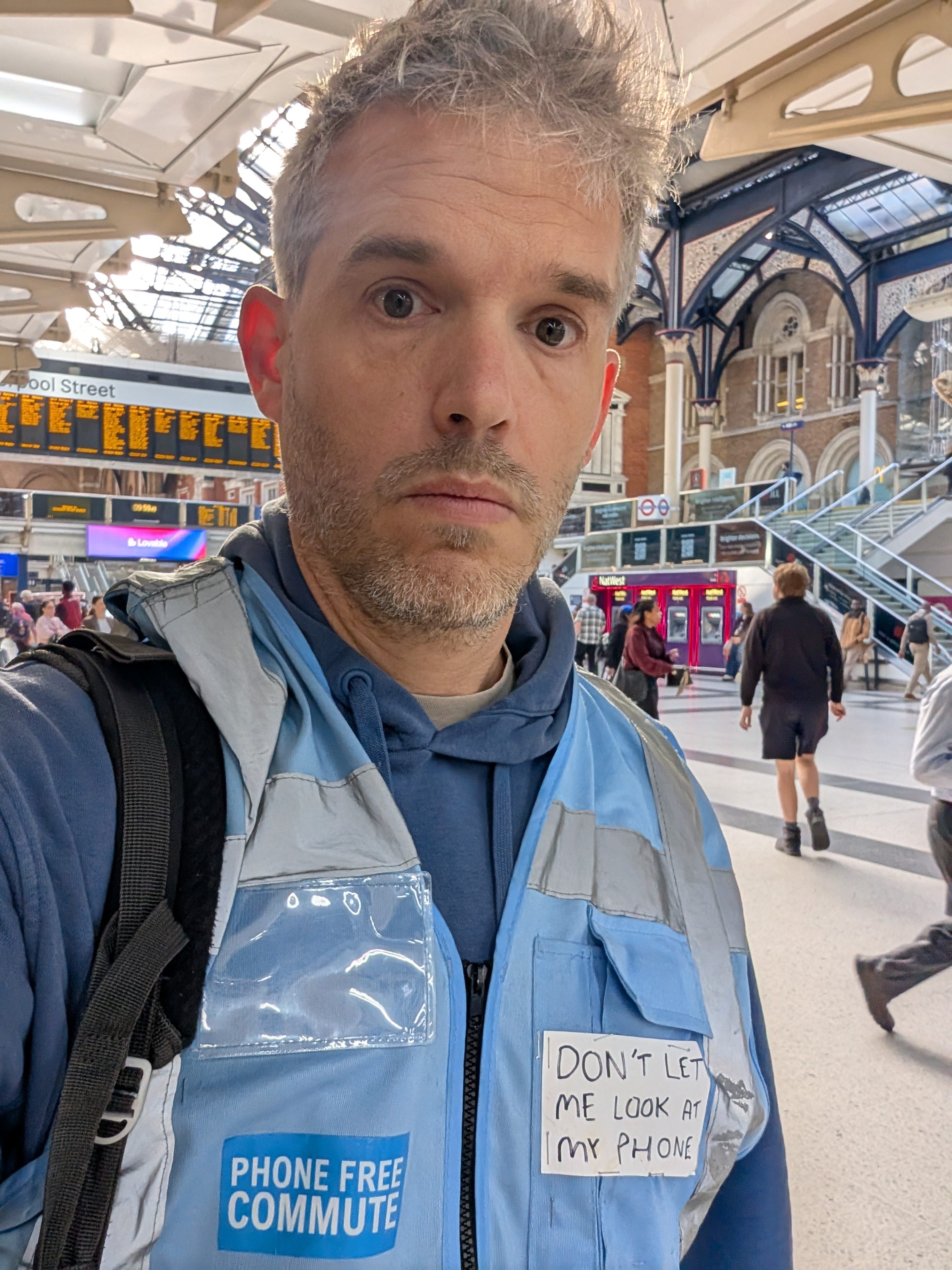
This morning I will begin Hour 257 of Phone Free Commuting.
To a lot of readers’ surprise, very few people actually talk to me on the commute.
But it does happen. Yesterday I saw a man looking at my high vis vest with a huge smile. A question seemed imminent. I warmed up my brain, ready for him sidling up with “What’s all this about then?”
I cycled through my usual responses, and got ready to deploy: “I made my daughter cry because I used my phone too much! And here I am!” accompanied by a shrug.
I gave him a big smile back, ready for the question.
And then I realised he was listening to a funny podcast, smiling at that, and looking right through me.
Fortunately we people who commute in high vis are immune to feeling awkward.
The Ballet Disaster was seven years ago this December.
It was one of those church hall type performances with plastic chairs. “Your children have been working so hard to learn these dances. I’m so glad you parents get a chance to watch.”
I sat down ready to watch. Sitting down triggered a quick burst of phone activity (back then, most things triggered a quick burst of phone activity). I don’t remember it in detail, but something like: a quick refresh of all three email accounts in the order 1, 2, 3, 1. A quick check of WhatsApp. Then I usually had some sort of work email draft on the go, and I would have updated it very quickly with a new turn of phrase that just occurred to me and I didn’t want to forget. Then I would worry about losing the email in drafts - that happens so often - so I would go back into the email app and copy and paste (plain text only!) the draft into Notes. Quick refresh of Guardian app, glance at a LIVE story. Refresh Reddit front page without meaning to, see something funny, click but then click back because I don’t have time right now. Then back to front page, refresh again. Then another quick check of the email accounts: no change.
I glanced up and my daughter was crying. She was dancing alongside the other girls, but crying as she did so.
For a fraction of a second I wondered why. And then I guessed. Perhaps I wasn’t so quick on the phone - I had noticed an interesting time distortion in situations like these.
Hmm. My daughter seemed distressed. And in public. And this could have been going on for a while. She needed urgent help.
Parents are capable of great heroics to help children in trouble. We’ve all heard stories of mothers lifting cars to save their children, conjuring an act of superhuman strength.
I conjured an act of superhuman intelligence: I know, I thought. I’ll pretend I was filming all along.
In one deft motion, I flipped on the camera. I had been holding my phone at a 45 degree angle - low but not as low as it could have been. Maybe I was filming her feet? That must be a thing with ballet, and I’m a very creative person.
I mentally communicated to my daughter that I had been filming for some time. I moved my phone around in increasingly ostentatious gestures. I pinched to zoom.
And it wasn’t just my daughter who needed to see I was filming all along. I realised the other parents had likely figured out the cause of my daughter’s crying.
They might tell my wife.
I stepped up my filming activity, shuffling in my chair to achieve the correct angle with the confidence of an auteur director. The people sitting on either side shuffled away from me.
And that’s how I got a video of my daughter crying because I used my phone, on my phone.
The footage would turn out to be surprisingly useful.
I apologised to my daughter. She seemed fine, and by the time we got home she was talking about something else.
I deleted the worst of the videos.
But not all. My wife might ask to see the ballet (fortunately she never did) so I kept some of the ones towards the end. In them, my daughter is recovering her composure. She is still visibly blinking heavily, and has the curious chin projection of someone who has been let down but is being strong about it.
As I watched them, I resolved once and for all to fix my phone problem. I was already known as “Phone Dad” and this was the wake up call I needed.
I began with Tactic One: Social Reinforcement. I shared my screen time with a group of friends. This encouraged me to compulsively and repeatedly check my screen time. After a few weeks of saying “yeah I know it was 7 hours but a lot of that WhatsApp time is calls” we all quietly abandoned it.
My wife and I tried social reinforcement too. We agreed to shout “Phone Challenge!” when we felt the other’s phone use was detracting from family life.
And we’re divorced now.
No, just kidding. But suffice to say we let this one go pretty quickly.
Tactic Two: Friction. You find this advice everywhere: all sorts of fixes to make the phone less pleasant and more difficult to use. Setting it to greyscale (I came to love film noir scrolling), putting elastic bands on it (we still find them all over the house), using restrictive apps (I installed and deleted them monthly). I put the phone here, there and everywhere and it came back like a faithful dog.
Each failure was more and more depressing.
I honestly think I would have given up… except I had the videos of my daughter crying. This evidence meant I could never quite drop the project entirely.
I changed tack. I came to believe that much of my phone use was entirely automatic - that I never consciously decided to do it. Reading around the subject took me to Tactic Three: Meditation. I tell that story here - it was the first thing that started to slow my phone use, in part because it helped me to see the automatic impulses that led me to the phone. It added internal friction to external.
After doubling down on that, and a slight overkill moment, I would end up combining all three tactics - social reinforcement, friction and some crucial learnings from meditation - into what I believe is their logical endpoint: commuting in a high vis vest.
Turns out the tool I needed was looking like a tool.
I felt bad about making my daughter cry. But I came to see the ballet phone pickup as entirely involuntary. Automatic and subconscious.
I felt far worse about all those moments over the years when I deliberately dismantled the friction and took myself back to square one.
I not only did this very consciously - I did it while owning a video of my daughter crying.
At one point I had found a particularly good restrictive app. I vividly remember the tired evening heading home from work when I deleted it, and in a “screw you” flourish, reinstalled Reddit. I just thought nah.
That app could have worked. I’ve had a good life - but it’s an understatement to say I wish I’d tackled this phone use thing sooner.
I don’t think I’m alone in being puzzled by flip-flopping.
Earlier this year I met a woman on the tube who was living with a very tough Instagram addiction. At one point, she told me, she had made progress by getting her mum to set a password.
But then some weeks later, she called her mum and got the password back. She looked so deflated.
A lot of self-help writers give phone fighting tips. Very few write about what happens when you entirely consciously abandon those tips, dismantle the barriers and go back to using the phone.
And why would they? What would self-help have to say about someone changing their mind? Priorities change. But then… I still had the video. What were my priorities?
As I went further down the meditative rabbit hole, I came across a way of thinking that might explain why I performed such spectacular reversals. And why the woman on the tube rang her mum for the password. And why so many seem caught in the cycle. Yes the phone is famously addictive and spectacularly useful, yes the apps are carefully designed to keep you in their orbit. But I came to think the strangest part of the story isn’t the phone at all - it’s the mind. The phone just shows it up. (More on this in a future post).
I came to believe that, ultimately, I wasn’t to blame for my flip-flopping.
My responsibility, yes. But not my fault.
I fully accept there is something comical about devoting so much profound thought to this, only to conclude that none of it was my fault. Not usually where soul-searching is supposed to end up.
But for now, in case I’m wrong and this is a convenient get-out, the vest has a useful extra quality.
If I had managed to tell the smiling guy on the train about my daughter, he would have taken my high vis vest as some sort of self-flagellation. As one reader on here wrote, a kind of Scarlet Letter.
I’ll take that. It can be the mark of the doofus.
I apologised to my daughter again recently. She doesn’t remember the Ballet Disaster, and finds the whole thing extremely funny.
And if I’m ever tempted to say “Phone Challenge!” to her when she’s distracted while doing her homework, she knows she only has to say “At least I didn’t…”
And she can just leave the sentence hanging.
Next week: why putting the phone down felt awful at first.
Confused as to what I’m doing? This short post might be a good place to start.
A lot of people seem to be considering new ways to fight the phone. I’m keen to find ways for those interested to compare notes and support each other, perhaps on a (hopefully not irritating) Substack Chat or similar. If this would be at all helpful to you, please message me on Substack.
This is part of a series of articles following 1,000 hours of nothing on the London commute. My free archive is available at phonefreewill.com, sorted into sections ranging from practical through to humiliating.
If you know anyone who’s tired of their phone use (or if there’s anyone whose phone use you are tired of) please share this with them.