

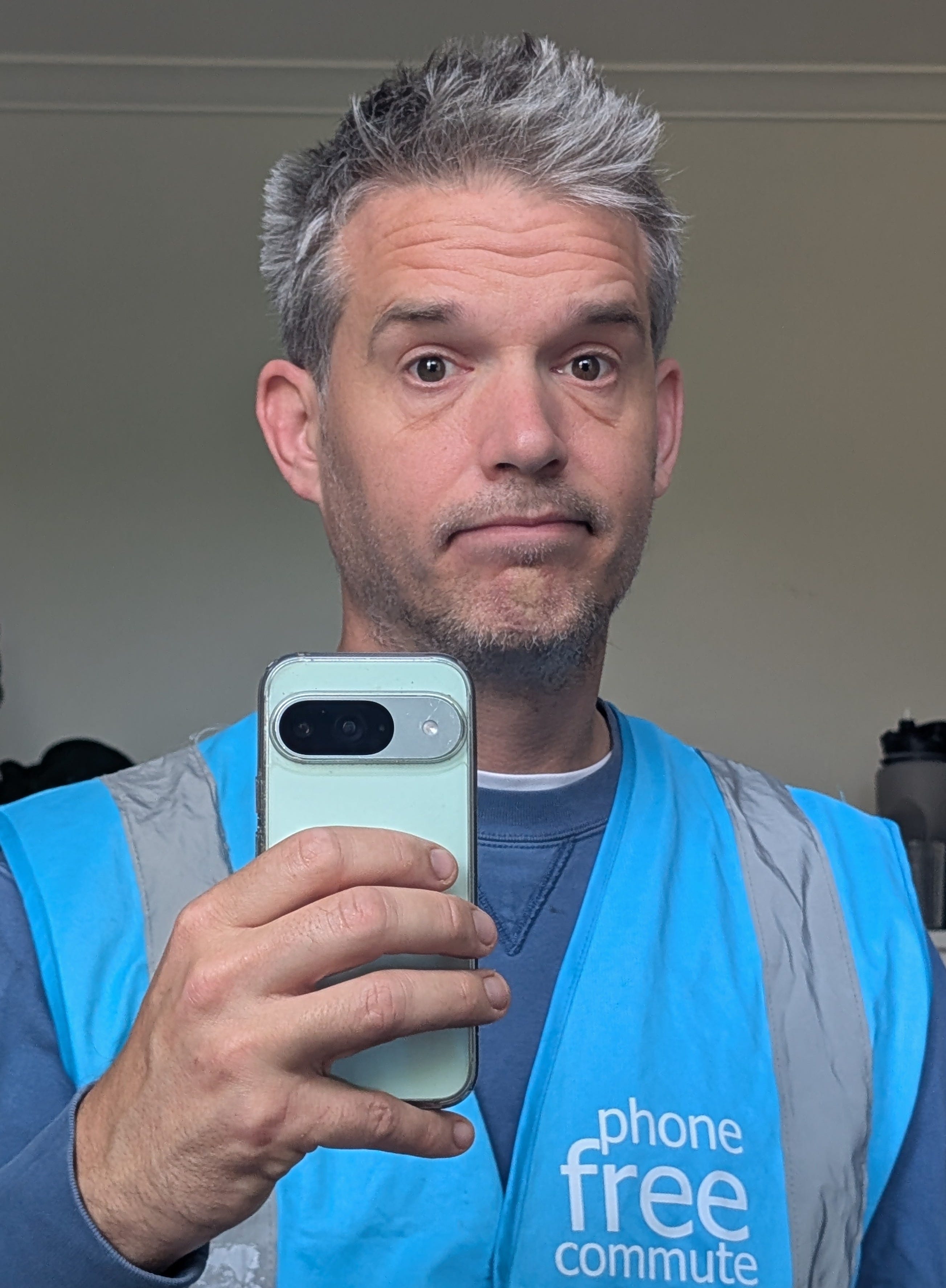
I rushed to look into the mirror.
It was as I suspected. The person staring back wasn’t me.
It was clearly the body I inhabited, but I had no control over its actions. It felt foreign and at one remove.
I wasn’t there any more.
And I never had been.
My first thought was that I had maybe overcooked this meditation business a little.
I only really started because I wanted to reduce my screen time. On reflection, I probably should have just got a flip phone.
My second thought was that I was going to dinner with my wife in a few hours and my loss of self might introduce a layer of awkwardness that could well ruin the evening.
Everything had changed.
I nervously checked the dinner reservation time on my phone.
Then I checked the classroom WhatsApp group, refreshed BBC News and verified that the robot vacuum was charging okay.
Nothing had changed.
A brief recap.
A few years back I made my daughter cry when I looked at my phone instead of her at a ballet recital.
In the years after, I tried everything to reduce my phone use. Nothing worked, which I found fascinating.
The journey that took me to the mirror started months before.
I saw that much of my phone use was automatic. It was initiated by a hidden me that I didn’t control.
I came to believe that meditation was the way of getting at that hidden me. And over the months I gained the power to say no to automatic me. It was excellent in so many ways - and the first thing to reduce my screen time.
I thought that the right response was to strengthen the inner me in control of that focus. But that ended up in what felt to me like a dead end. Albeit a very strange and pleasurable one.
Change of tack.
The spare room experience had opened my mind (a little). I had long been familiar with the Buddhist concept of no self. It’s not an idea that’s easily defined, and indeed definitions genuinely vary.
I learnt more about one way of thinking about it from reading Sam Harris’s Waking Up, and using his app of the same name. It was genuinely fascinating stuff.
I listened to it all.
These days I am called upon to give a lot of lifts. The kids go to tonnes of classes and playdates.
And the time spent ferrying them around is doubled by Surbiton’s endless roadworks.
When I was in a good mood, my preference was to drive in silence (when on my own of course! When the kids were there I talked to them - not that dedicated).
At some point in the process my inner voice had become a lot more quiet. At first this had slightly perturbed me, like missing an old friend. But it didn’t disappear entirely - it just said fewer, better things.
The arrival of new thoughts became more sporadic, and as a result far more noticeable.
One day late last year I was driving back from an errand of some sort.
A thought arose. Annoyingly I don’t remember what it was - likely about why Surbiton’s many roadworks were often simultaneous.
Then came the recognition that this thought had popped out of nowhere, that my conscious mind hadn’t originated it. By now this was a trained-in response - a standard occurrence.
But what happened next was new: my mind realised that the recognition that the thought had popped out of nowhere had itself popped out of nowhere.
And then this recognition - also from nowhere, and unauthored.
And this one too!
And onwards spiralling on forever. No thoughts were mine. It wasn’t possible for my conscious mind to originate anything. There was just awareness.
Previously I would have said that “the meditator” who noticed this was the real me. Now I realised there was no such thing. That was just another thought. Thoughts just came. Oh.
I knew immediately (it’s tempting to say “my mind” knew immediately, but we won’t go there) that this was very significant indeed.
It was accompanied by a shudder up my spine and odd changes to my visual perception. Instead of me moving forward, the world seemed to be moving towards me. Objects within vision seemed less substantial.
They probably were substantial, so I drove carefully.
I made it home just fine.
A dim memory of something I had read or heard made me rush to the mirror.
Ohhhhh.
Rather than feeling pleased with myself, I remember feeling a little silly. I had gone and lost my whole self and the phone thing still wasn’t fixed.
As I prepared for dinner I worried that I had done myself irrevocable harm. Would I ever meaningfully connect with my family again? Was I now like the guy in The Diving Bell and the Butterfly?
No I was not, I thought. Here I was grateful to have listened to so much Waking Up. No need to panic. This had always been the case.
When I had noticed the automatic pickup of the phone, I had compartmentalised myself into a conscious me and a hidden me. There was the conscious me that saw, heard and perceived the world. And there was a hidden me that lurked behind the scenes, pulling the strings.
This was a mistake. All thoughts just arise, created by the biological brain. Some of them happened to be accompanied by a further thought which suggested they were authored by the conscious me. This further thought, this claim of authorship, was a fib. The conscious mind couldn’t author its way out of a paper bag.
If my biological brain wanted to eat, it didn’t bluntly flash a message saying “Eat”. It instead generated a thought with the feel and specificity of authorship: “I should get one of those new double Big Tasty burgers - they’ll stop doing them soon.” My brain clearly wanted me to take good care of my genetic offspring, and it generated lots of thoughts tailored to the moment like “Must order them new trousers”.
Big Tasty, trousers, all of it - cooked up by my brain, but served to me as if “I” had just thought of it. That was the fib.
The recognition of the fib changed nothing external. As if to prove that, my daughter walked past me and said hey. Utterly automatically I said hey back.
An image came into my head - a car on autopilot, but the driver was firmly gripping the wheel. All he had to do was let go - the car had always been on autopilot. Ohhhhhhh.
At that point a new type of meditation became possible. A now that encompassed everything. The immediate awareness of thoughts with no sense of authorship. There was no need to focus on anything. No need to label thoughts. Ohhhhhhhhhhhhhhh. I shuddered a little again.
All sorts of meditation had got me here, but I realised I didn’t need to set aside time for it any more. I could theoretically access this new state any time, anywhere.
Maybe this would free up time for a new hobby?
Lots of people say that padel is good.
I went to dinner with my wife.
I needn’t have worried that I wouldn’t be there. As soon as we got to talking I completely forgot all of this. Not that it wasn’t true - it just slipped my mind.
And to this day I have been lucky. It has felt like a one-sided deal. If I’m having a great time my thoughts are my own and I am as I was.
If a negative thought arises then - not always, sadly - I am liable to remember everything. I switch into just feeling the thought. And it can’t get me. Not always. But enough.
Beyond that there are no great changes. I can’t move pencils with my mind.
And I am not a better person. In a way there’s no surprise here. We’ve learnt time and time again that meditative adepts have feet of clay.
Indeed, I still leave all the cupboard doors open when I’ve been in the kitchen.
My life carried on normally. I kept it to myself. There was no outward change. No-one would question my sanity.
Until the day when it suddenly made sense to travel to work in a high vis vest that says Phone Free Commute.
In the weeks after I looked in the mirror, my mood got worse.
One day on the 9.17 I found myself Googling the problem.
I could step out of my mood. But I realised that even so it was still worth being in a good mood. It was still worth having positive thoughts. Though negative thoughts didn’t affect me in the same way, they affected how I treated others.
How could I improve my mood and thoughts? I knew that I needed to get upstream of them, to the physical health of the brain that was creating them.
I believed the big factors were sleep, diet, exercise, mental rest and phone use.
And it was the last two I had let slip.
After the mirror event I had decided I didn’t need to set aside time to meditate. So I dismantled all the elaborate habit structures that propped that up - and phone use just filled the gaps.
This shouldn’t have surprised me - I’d already convinced myself the mind just naturally defaults to the phone. The biological brain seems to love it, because it can be anything the brain wants. So however far we may drift, we stay in its orbit. Our brain endlessly generates thoughts like “Ooo, maybe I should check my emails again”.
But that 24/7 checking never lets my mind rest.
Mental rest and phone use are meaningfully opposites. One makes you feel better, the other makes you feel worse.
Unless something is done then one eats the other entirely. If it’s not scrolling or checking and fixing, it’s letting podcasts fill the silence when I walk Jumble.
So now I needed, for the 45th time, to find a new way to guard my mental rest.
But now I knew with certainty that my willpower couldn’t be trusted. Whatever desire I might have now to stop using the phone, there was no fixed self to carry that torch. New thoughts would come along, as surely as the weather changes.
I suddenly realised why I couldn’t stop eating cheese out of the fridge - the person that resolved to knock that habit on the head was only a passing thought. A later version of me would scoff at the idea of restraint - and scoff the cheese. The thoughts that talk us out of good habits always arrive with the full, false confidence of authorship.
So I created a regime to guarantee mental rest that I knew a future thought wouldn’t unpick.
My life was busy. My train and tube commute was the obvious time for rest. But my attempts to do so had been defeated by the phone again and again. I couldn’t just turn it off - I knew by now it would just get turned back on again.
No, I needed something bigger. Something to end it once and for all. A fitting end to years of struggle. I made an extravagant and highly visual commitment that I would never use my phone during this time.
I ordered a bright blue high vis vest that said Phone Free Commute. And I used the commuters around me to reinforce accountability.
The tool I needed was looking like a tool.
I felt like an idiot. But that was a feeling I could now observe with equanimity.
The vest guarantees two hours of phone free time. Which guarantees two hours of mental rest. Which feels like enough to counterbalance the harm that my tech use is doing at other times. It is a thumb on the scale.
And that - as far as I understand my brain - has kept my mood very positive for much of the six months I’ve been doing this.
But obviously that’s only a part of the story. I also can’t deny there is something evangelical here.
After all, I am writing about this.
There is something about the whole experience that has created an unshakeable confidence in what makes minds happy. An unshakeable confidence in a message that won’t stay in its box.
Someone who commutes in high vis should probably be wary of giving advice. But people keep asking. And I’m a TV producer and I pitch for a living.
So here’s the pitch.
If I’m right about the conscious mind, please consider the implications. We might all be on autopilot - and that autopilot might be a life lived in orbit of the phone. We believe we consciously think of a new reason to pick it up all the time, but that feeling of it being “our” idea is a fib. Why does everything lead to phone use? Why does it fill all the gaps?
Or if you don’t believe that, please at least consider meditation. I love it, and I think most people would get something from stopping and watching their minds for a moment.
Or if you aren’t convinced by that, then maybe just use your phone less.
My guess is that phone use not only sucks up time, it lowers our mood in a way that’s hard to attribute to its true cause. You might be worried about your work or your health - perhaps part of the reason why you worry is that your phone use is denying your brain mental rest.
If we want to continue to own a smartphone, we need to recreate the incidental mental rest it has eradicated. Those moments waiting for the bus where now we listen to a podcast.
This is exceptionally difficult and unpleasant at first, but if done daily over weeks it gradually becomes easier. I think meditation techniques can help it feel more palatable and productive. And then, very gradually, a feeling of optimism re-emerges. And the mind starts to default to the present moment.
And in those moments of ringfenced rest, we can start to hear our mind calling us to the phone - and learn to say no. Without this mental training, we are likely condemned to a future of automatic phone pickups and of creating barriers and dismantling them - the yo-yo screen time cycle.
And this newly trained power to refuse the phone, combined with a belief in doing nothing as a useful (if not pleasant) alternative, comprises true Phone Free Will.
I can’t know that what worked for me will work for you.
I can’t know if my chosen form of rest is better than gardening or reading or wild swimming. My son doesn’t use screens before 6pm and spends his time bouncing on the trampoline.
But however you aim to get your phone free mental rest, maybe we could boil down everything learnt from the past few years to two words: regular and non-negotiable.
Regular means adopting the training ethos. Building it into your day. Doing it with no expectation of result.
Non-negotiable means imagining I’m right about what I saw in the mirror. Any conviction you have now about reducing phone use will pass. Another thought will arise, namely to start using the thing again. The Evil Advisor will think of something. We cannot trust the decisions of future us.
In a calm moment, we need to do enough to prepare for a future when we will be tempted. What’ll work will be different for each of us, and we might need a spirit of trial and error.
Trial and error is how I ended up with my version of regular and non-negotiable: commuting in a high vis vest.
Maybe don’t do that - it looks really odd.
But also look again at the train carriage around it, with its near 100 percent phone use.
That looks odd too.
I am seized by a conviction that won’t go away. About a harm we know all too well but don’t know at all.
Like Bruce Wayne, I have a day job.
Unlike Bruce Wayne I can’t be Batman at night. I have kids.
But I can be a superhero of the in-between.
I stand proudly in the gap. The previously incidental pause where the phone use has destroyed mental rest.
I stand in the biggest gap of all, the commute to work.
But I stand - arms crossed, high vis flapping in the breeze - in all the gaps.
The moment when you are waiting for the kettle to boil. The moment when you are left alone at the restaurant table when your spouse goes to the toilet. The moment standing in a queue.
I stand as a high vis idiot with no self and no self-control.
And I say:
Dude… you just checked that app like 30 seconds ago.
If you’ve made it here, a heartfelt thanks for reading.
If this feels a little like it came out of nowhere, the start of my journey is here.
If you know anyone who might be tickled by this, please share below.
Share
All my pieces are on phonefreewill.com.
I'm late to these posts, but find it all very inspiring. So much of what you say regarding not actively deciding to use your phone and struggling to meditate resonated with me. Thank you for sharing
Thank you for this. I'm currently attempting to "awaken" to my true identity and use my phone less so this was timely, and an enjoyable read.
P.S. I have yet to awaken, and yet to use my phone less : )