


It’s Day 23 of the Phone Free Commute experiment. I'm doing absolutely nothing on my train and tube journey across London, one hour there, one hour back.
Thanks largely to the high vis idiot vest, I have mainly managed to stick to this.
I should declare that I briefly used my phone at Vauxhall station. I gave in to a persuasive pitch to donate regularly to Alzheimer’s research, so I had to go into my bank app. It’s an important cause, but if I’m honest I wasn’t donating out of altruism but sheer mindnumbing boredom.
Beyond that, I haven’t looked at my phone at all.
Other people’s phones… well, that’s another matter.
Don’t get me wrong, I’ve definitely done a lot of training to be present, listening to my mind incessantly asking me to pick up the phone. All the things I advocate.
But after a while, it’s just too tempting to see what my fellow commuters are up to.
These are the broad categories, in ascending order.
Movies and TV. The landscape hardcore. Huge stars, teeny tiny screen.
Chores. Until it freezes on checkout.
Playing games. Candy being Crushed.
Podcasts / Music / Audiobook. Soon I will get so bored that I will just ask.
Messages / Emails / Work. Fair enough.
Scrolling - Full Frame Video. TikTok and the many apps that now look like it.
Scrolling - Text & Pictures. Mostly news and social media, but could be long emails? Need to get closer or get a better angle.
But one huge category is definitely the most interesting:
The Ditherers.
For these people, the home page is a decent proportion of their screen time. They cycle quickly through their apps, making quickfire checks. Often they’ll put the phone away, and then get it out again in quick succession.
This is a feeling I know really well, and it’s definitely one I’m prone to in my house. Going in several directions at once on the phone, alternating with realising you should probably put it away. Check messages, check LinkedIn, put it away, Whatsapp, TikTok, put it away, check same messages. And then you stand in your kitchen and you think, what was I doing? Oh yeah, feeding a baby.
You know those moments?
I help make ‘em.
THE ATTENTION ECONOMY
I’m a TV producer.
Years ago I didn’t consider myself a part of this story, but my job has changed a lot. Today, TV programmes don’t just compete with other TV programmes. They now compete with games, news, podcasts, messaging, YouTube, TikTok - everything and anything that could get your attention. So I am now part of what’s called the attention economy.
Media expert Evan Shapiro documents this new intense global battle, creating glorious maps of the multi-billion dollar companies involved in the war for your attention. The scale is jawdropping.
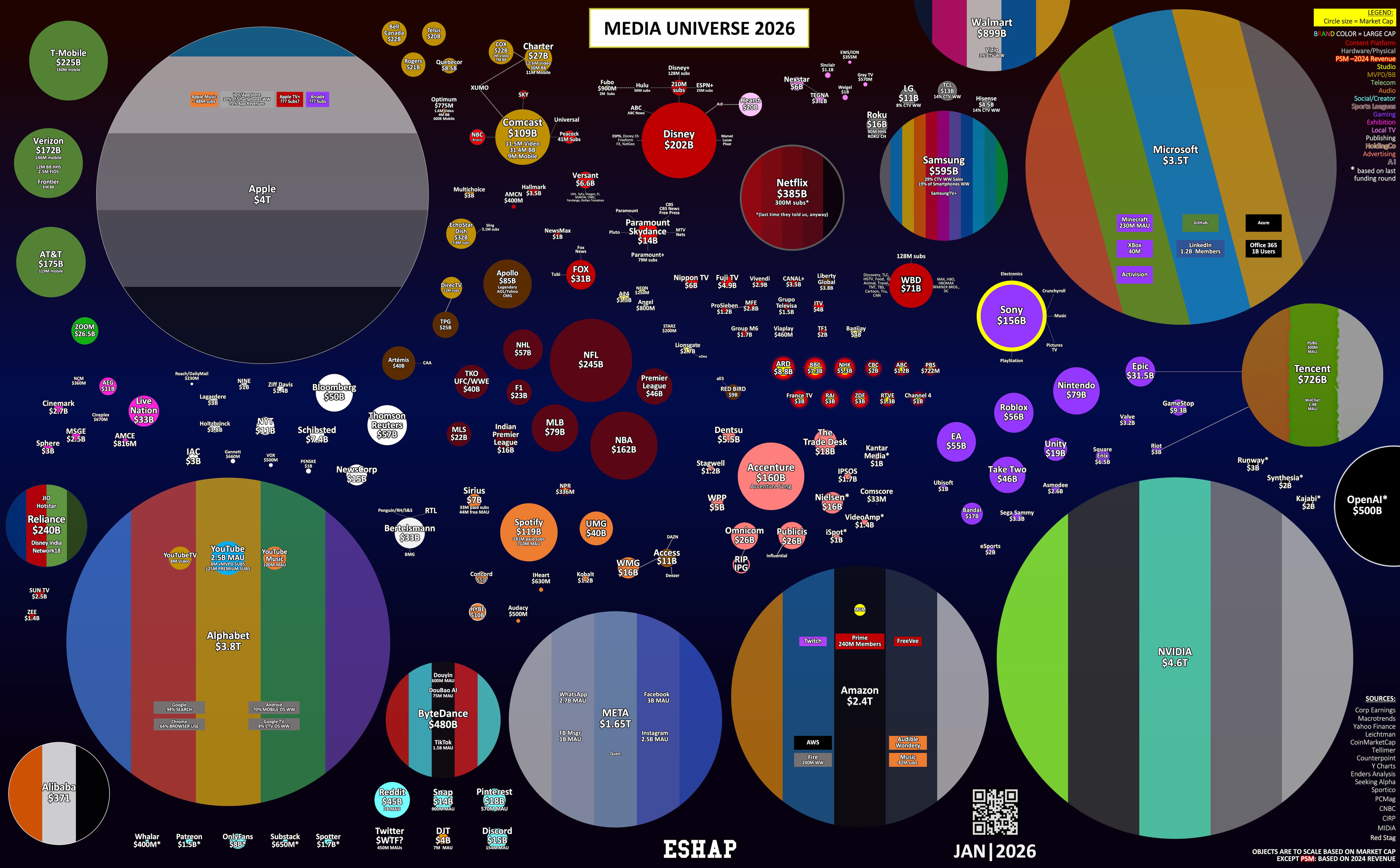
Previously disparate companies have been drawn into one huge competition because increasingly the devices we use can access all types of content.
The most versatile device is of course the phone. And it doesn’t just let you access anything you like. It allows you to access it on the toilet. In all the gaps in our lives. That 24/7 possibility means there is a lot of money to be made. And of course, the tube commute is the moneyspinning king of the gaps.
We might have opinions on different ways of using the phone. Some content is harmful, some is profound and life-changing. Some Whatsapp messaging might feel excessive, some might feel necessary. TikTok feels bad, news feels good (or does it?) A substack piece about a midlife crisis dad wearing a high vis vest is best of all.
But no matter how noble the ideals, no matter how incredible the piece of work, today it’s all part of an intense 24/7 war for your attention.
A war to capture the castle that is your mind.
HOW TO CAPTURE THE CASTLE
We all know by now that the geniuses behind the attention economy have got all sorts of clever weapons to storm your mental defences:
Our brains like movement and bright colours, so videos appeal more than text.
We humans are hardwired to form perfect teams for mammoth hunting. So we are absorbed by comparing ourselves with others on Instagram and LinkedIn.
Our brains love to assess danger. So we drink in crime stories, and those pieces on the Daily Mail that say something like “I thought it was a harmless lump but it turned out to be cancer”.
The list of weapons is endless, and more and more often it’s AI that chooses which ones to deploy.
But for all these clever tactics, here’s the weird thing about the attention economy: no-one in it feels like they are winning. Because no-one manages to capture the castle for long before someone else grabs it.
They might get your attention with a great movie at home, but as you settle down to watch it you’ll pick up your phone and check something else. There’s no big winner in this war.
But there is a loser.
THE WALLS ARE DOWN
The phone is the first ever 24/7 device. And certainly for me, it feels like all this explosion and noise - all this banging away at the walls around my attention - has turned them into rubble. The walls are down, and they’ve stayed down.
To storm my mental castle, it used to be that you needed an army. A horde of Lord of the Rings-esque warriors to breach the citadel. Someone might pull out all the stops, get all the stars and make an unignorable new drama. Sure, that will win my attention.
But now the walls are down, my castle is just as easily captured by a confused Hobbit wandering in the back door. Like a scan of the LinkedIn feed so I can double check how badly I am doing in my career compared to my peers.
QUIET REBELLION IN THE QUIET CARRIAGE
Some phone activity feels worthwhile, some less so. I’m not a fan personally of judging any of them. It’s more important to recognise the effects of allowing our attention to be competed for 24/7.
I make TV and I like TV. In all its forms. But I don’t want to be a casualty of a trillion dollar war in every minute of the day.
I want to build in a regular, habitual, planned daily break from the explosions and noise. A quiet rebellion in the quiet carriage.
And in that break I want to rebuild the walls, by repeatedly bringing my mind back to the present.
I’ve also wondered sometimes whether the walls being down hasn’t let in other distractions too - even if they don’t come from the phone. I noticed my mind more easily gets captured by worries about the stupid thing I said to Clive at work (my bete noire), about the future, about everything feeling like it’s going wrong in the world.
More and more, life has that late night in bed mind-wandering feeling, where any worry, no matter how stupid or fleeting, can occupy you fully. Maybe if the walls are down, they’re down for any unwelcome intrusive thought.
I should also add, my attention is not a castle really. It’s only a 1930s semi.
But even so, it’s worth dedicating a quiet part of my day to rebuilding it.
I am absolutely a "Ditherer". I cannot tell you how much time is spent compulsively checking my texts, then my messenger, then my email, then reddit, then youtube. Over and over and over. Sometimes literally 5 minutes after I just did it I'll do it all over again. For years and years at this point.
That data on the map is a fascinating insight, thanks for sharing.