

I’ve had a couple of weeks away from phone free commuting, and coming back to it all feels a little unfamiliar.
But for once, the strangest thing hasn’t been putting on a high vis vest.
It’s the wall of phones.
It’s always been the case that pretty much everyone is on the thing, but I’d somehow got used to it. It took a break to help me see it afresh. And wow it’s a lot of phones.
I’ve been doing this now for 233 hours across over eight months. And after all that time, I can see the carriage in two ways.
One person using their phone is unremarkable. They look like they are bored, and filling the time by entertaining themselves. Or catching up on a chore. Or messaging a friend. All very understandable. They remind me of me.
But as a collective mass, as a sea of phones and faces seen over months… that looks and feels very different.
Just occasionally, like a magic eye picture, a very different carriage comes into view.
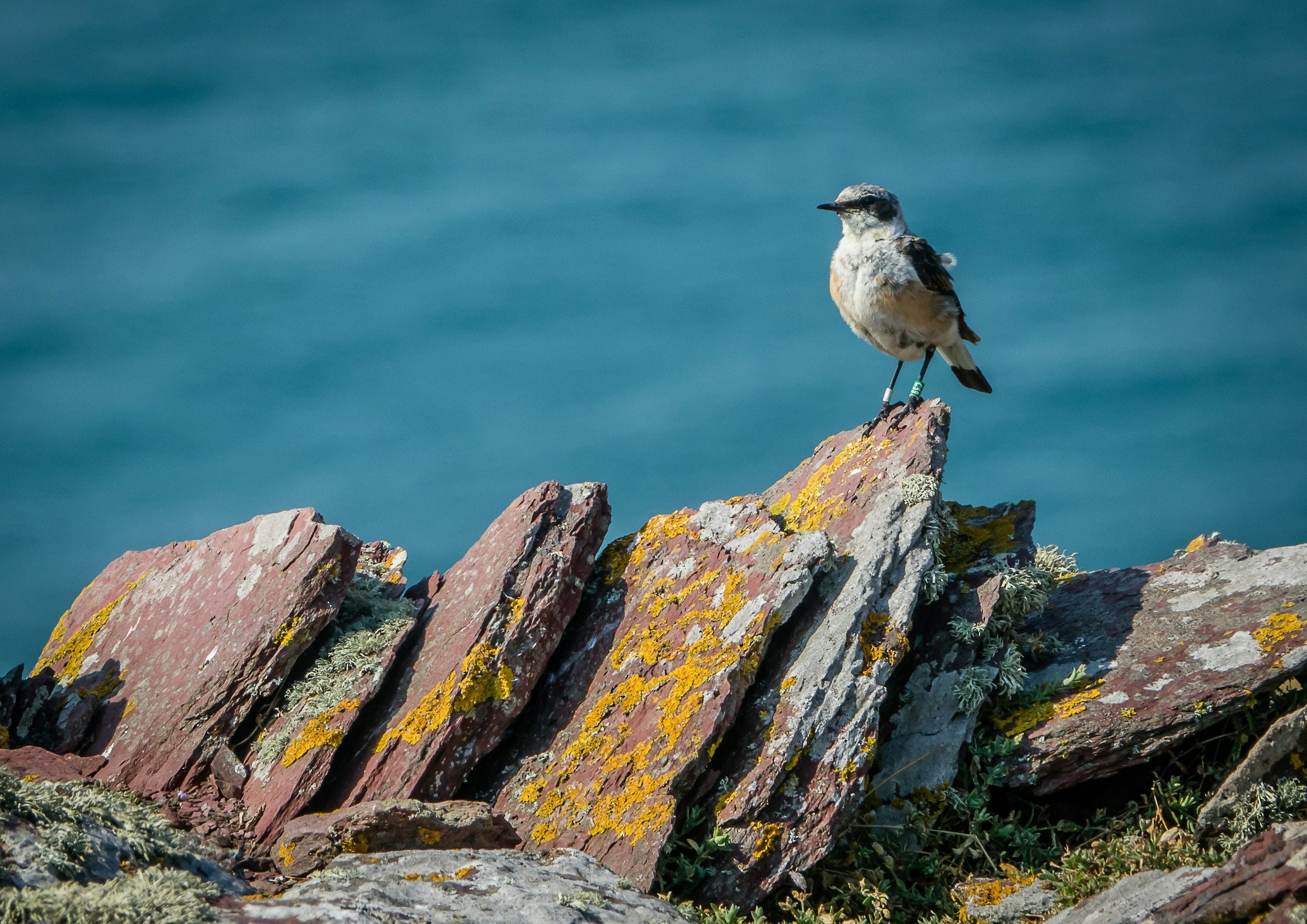
I once listened to a podcast about a bird called the Northern Wheatear.
It’s absolutely tiny, weighing less than a packet of crisps. It spends the first few weeks of its life hopping about, doing whatever little birds do.
And then one day, with no influence from its parents and with no-one to follow, it suddenly decides to up and fly from its native Alaska all the way to sub-Saharan Africa.
The journey is ridiculously further than it has ever flown before. It takes about three months, because rather than flying direct (across the US and the Atlantic), it chooses to go West, flying across the whole of Eurasia.
It seemed unimaginably absurd to me. I had a mental image of a bird living in Alaska, bobbing about, with maybe a nagging feeling it was getting a little nippy. And then thinking, I know, here’s something out of the box… maybe I the forest that I live in is really on a great ball, and different parts of the great ball have different temperatures. So maybe I’ll fly for months on end. I won’t stop when things become warmer and therefore better, I’ll keep flying until I reach a very specific place that I can imagine perfectly, even though I’ve never seen it. And you know what? I’ll take the long way.
Of course, logically it can’t be that way. It can’t be that the bird just has a moment of inspiration.
It must be some sort of inherited biological programming shaped by natural selection. Just as the bird has evolved to have wings, so its brain has evolved that when it reaches a certain age it migrates.
We have a dog called Jumble, and he loves us very much.
If he sees us after some time away he goes crazy. He tries to get as close as possible, jumping up at us, and wrapping himself round our legs. Even as he does this, he wants to be even closer, making a low growling noise which seems to indicate his frustration at not being able to occupy the same physical space as us.
We cuddle and stroke him and we look in his eyes and we see deep love reflected back at us. This love must be consciously generated by Jumble.
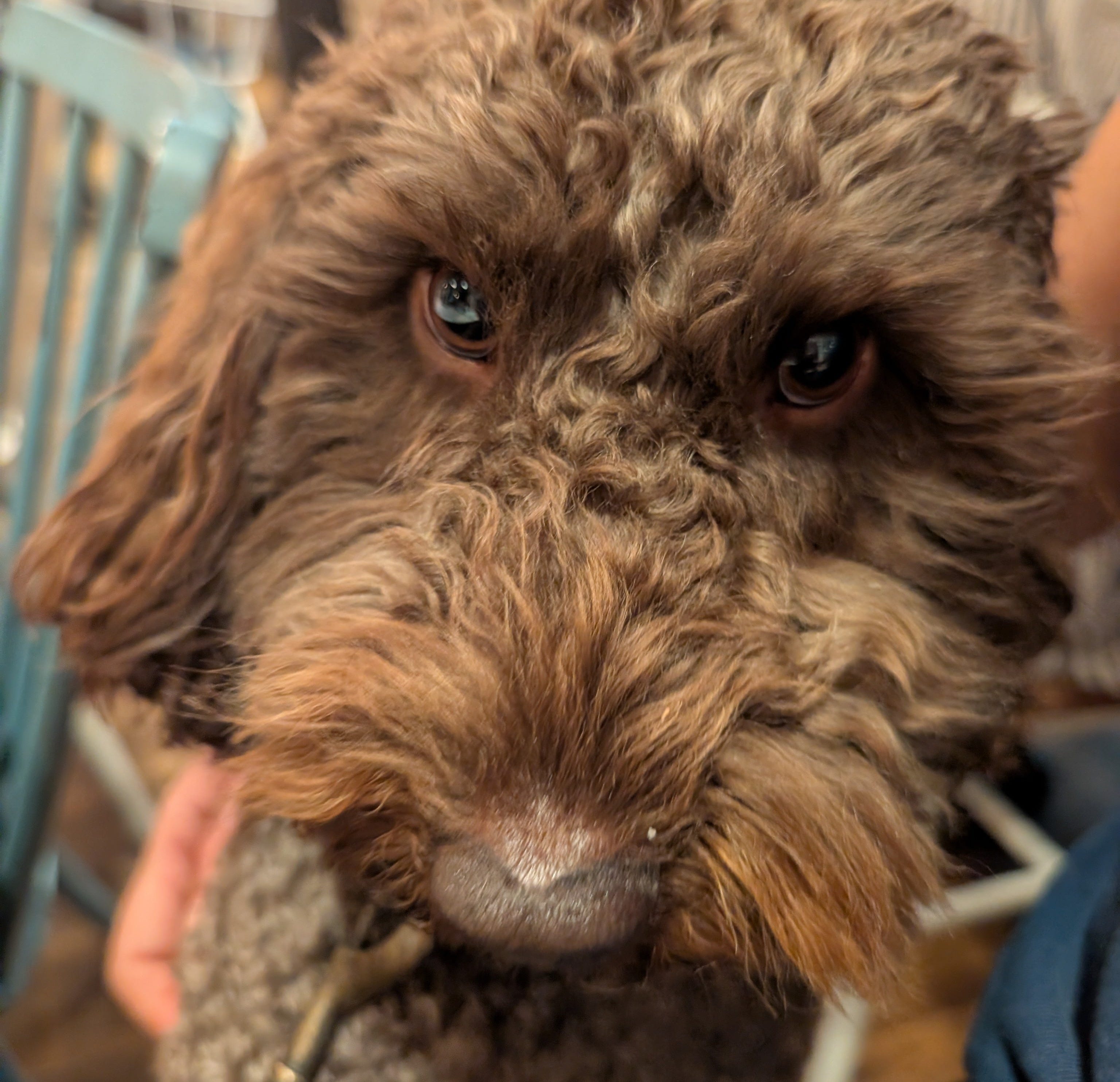
But deep down, we know that there is some sort of biological programming here too. We humans have selectively bred dogs, and we have chosen not just physical traits but also mental ones.
And if we could guess one biological fundamental to the unnaturally selected dogs’ brain, it is surely to love humans.
Does Jumble consciously love us, or is he acting out programming like the Northern Wheatear?
Let’s face it, given the evidence, it probably is biological programming.
But I’m not putting in all this effort into having a dog to think that way. So I’m going to go for conscious.
But I’m not consistent. Every time we get out a dustpan and brush, Jumble goes bananas, yapping and barking and attacking the broom.
In this case, I choose not to think of it as a conscious choice. It is too bonkers. This is definitely some sort of biological thing.
So loving me: conscious. Going crazy at a broom: biology.
My choice. He’s my dog after all.
Science says humans are animals too - evolved from apes - and therefore with brains that hold inherited programming, like a dog or a Northern Wheatear.
But it doesn’t feel like that. Because we know what it’s like to be inside a human. At any given moment, it feels like we can decide to do whatever we like afresh.
Years ago, I was ordering my kids’ school meals on the stupid, stupid online system, thinking what a great father I was for navigating such a glitchy awful website just so my daughter could be fed.
And I had a weird telescoping moment.
Wait a minute, I thought.
I devote a lot of my time and energy to my children. I’m very proud of doing that. But isn’t that exactly what my biological programming would want me to do? To pass on my genes and ensure their success?
But the urge to look after my children doesn’t come from a separate part of me. It comes instead as a thousand seemingly original ideas, ranging from a conviction that Bluey would be better for them than Cocomelon to the nagging feeling that I should probably battle with ParentPay once again to check that the jacket potato order did actually go through.
Still biological programming surely - but perceived as lots of individual original conscious thoughts. Huh.
As an animal I need to eat. But it’s not like the thoughts about eating are separate from my other “rational” thoughts. I don’t get a flashing light on my heads up display like Terminator saying “Food levels down to 30%” interrupting my otherwise higher reasoning day.
No, instead I “create” an entirely original thought saying “I have never tried that new Double Big Tasty. I wonder what it’s like. I should get it before they stop doing it.”
And thanks to a thousand different independent consciously generated thoughts like this, I stay fed.
For years this feeling that all my thoughts arose from biology was an unresolved suspicion. But something changed irreversibly after looking in a mirror after a lot of meditation (read more about that here). The feeling that there was a conscious “me” originating the thoughts fell away. I was just left with a biological brain that came up with everything - including the sensation that the conscious me was the author of it.
And though I still shudder occasionally to have lost my authorial self, there’s been a big plus side.
There’s now no division between my biological impulses and my conscious thoughts. The former generates the latter.
Good news! I was not the author of the decision to eat cheese straight from the fridge, without a plate or a knife.
And yay! It’s not my fault that I interrupted a pleasant Saturday to think about whether Clive from work hates me.
And above all, it’s not my fault when I use my phone all the stupid time.
Not my fault, but still worth fixing.
In doing so, my chosen method is to train to ignore the succession of thoughts pulling me to the phone. Each one seems individually convincing, but if I keep giving in to them I’ll spend my life on the thing.
Learning to ignore thoughts is not easy, and at this point ordinarily I’d witter on about mindfulness, and setting aside a bit of my day each day to practise. But let’s change the record shall we?
The train carriage isn’t just where I practise. It’s where you can go to see humans with nothing to do. I’ve seen thousands of people over hundreds of days, and each of them must be experiencing individual thoughts and impulses. But all of those thoughts and impulses are ending up at the same result: use the phone.
So I don’t need to watch myself over the years to see the pattern. The train carriage is where I can go to see my own mind multiplied many times over.
What is this great undercurrent so strong it sweeps all before it? Why does the human brain inevitably reach for the phone in any given spare moment?
Dogs are halves, looking for their other half. They’ve evolved that way. And humans complete them.
Humans themselves seem equally incomplete. I have spent many hundreds of hours in silence now, and there’s not one moment that has felt fully satisfactory. Not one moment that hasn’t felt like it should lead to something else.
We are the animals who look at everything with dissatisfaction, and want it to be checked and improved. We are the people who look at a spear and say “not good enough” and keep making it better, and before you know it we have built cities, fractional reserve banking and Surbiton Station.
We are relentless in our restlessness. And maybe this is the underlying biological driving force behind our constant use of the phone.
The phone is omnipresent and infinitely malleable. As such, it can be anything our biological brains need - a check on social status and a check on fear levels. It can simulate the sensation of everything from good company to reproduction. And of all the biological drives it short circuits, none is more powerful than the simple act to check, fix, check and check again. Nothing is more human than that.
Maybe over thousands of years natural selection shaped us to be incomplete because the relentless drive it gave us was so successful.
And around two decades ago that process reached its end. We invented an omnipresent, omni-capable device that offers to make us whole.
In the same way we complete dogs, phones complete us.
Well, almost.
Think of Jumble, wrapped around our legs, rubbing his face into us as hard as he can. And still making that frustrated low growling noise.
I can’t say with certainty what drives our phone use - after all I’m just a man in high vis with too much time on his hands.
I don’t know why Jumble goes crazy at a broom. But thanks to knowing a little about his brain, I do know the right move isn’t anger or judgement.
Just patient training.
Thanks so much for reading! If you know anyone who’s tired of their phone use (or if there’s anyone whose phone use you are tired of) please share this with them.
Posts are now fortnightly, but if you ever want to read more, all my posts are free (and neatly categorised) at phonefreewill.com.
This is part of a series of articles following 1,000 hours of silence on the London commute. The very strange story of how that started is here.
I enjoyed this thought provoking post. For my doodle, it's the either the vacuum or the leaf blower