

Welcome!
This article is part of a long-running experiment to reclaim minds from the phone.
We’ve all noticed how phones waste our time. But in hidden ways, they also destroy our mood.
We all feel ground down by worries about work, about our health, about the world. But it could be that behind the scenes it is our heavy phone use that is to blame.
Not having a phone is near impossible. We likely need them for our lives and our jobs.
Many of have tried everything to cut our phone use, but found whatever we do, we continue to pick it up entirely automatically.
The answer I believe is to carve out a clear, daily intentional silence from the phone. You could call this intermittent digital fasting.
In that time we train our mind to stop automatically picking up the phone, and reverse the phone’s (frankly massive) psychological effects on us.
This daily training can be done at any time of day in any way that suits you. Could be driving, could be a morning walk, but for me it was easiest in my daily train commute.
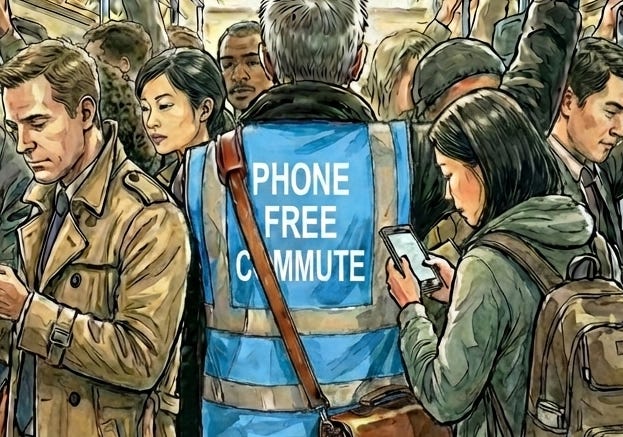
This post serves to answer all the questions people normally ask me when they see me in the Phone Free Commute high vis vest.
When it’s underlined, I’ve linked to a post I’ve written, for those interested in reading more about my abject history of phone addiction failure.
What on earth are you doing?
I’m a TV producer and father. A few years ago I made my daughter cry when I looked at my phone rather than watch her during a ballet recital.
When I realised I was picking up the phone automatically I decided I needed to take time to train my mind against this effect.
I learnt how to meditate, and spent 18 months doing so daily. It helped, but now I’ve decided to devote much more time to it. (A bit of a long story - explained here).
I have a busy life, so I use my commute for it.
Because I have failed to resist the power of the phone many times before (and because why not, life is short) I do it wearing Phone Free Commute high vis. The social commitment has worked - I don’t look at my phone at all on the commute.
And it’s improved my life far more than I expected.
What is Substack?
My writing is hosted on Substack, which allows you to get my posts emailed to you once a week on Tuesday mornings. Avoid the distraction machine and receive these direct.
Obviously, it’s totally free - I’m doing this because I believe in it.
The commute is the one time I can get my phone stuff out the way. I’ll just tackle my phone use at home.
That is what I did for years.
But then I learnt that phone use creates phone use.
And because phone pickups are automatic, they near impossible to fight. Battling them at home is depressing, stressful and almost everyone feels like they are failing - this is a hugely common experience.
Try something new.
If you have dead time that you can use for anything, use it to rewire the brain.
At least I have something to do on my commute. What’s it like having nothing to do?
I do have something to do.
I’m training the mind to get rid of the instinct to pick up the phone automatically.
I use a technique inspired by mindfulness that allows me to watch my thoughts rather than to just have them, to separate “me” from the urge to scroll.
And to be honest, that’s hard.
Then the mind gets filled up by whatever you don’t want to think about. For me, that’s work worries - why did I say that to Clive? Clive thinks I’m rubbish etc.
And then I found I experienced a weird kind of loneliness. (Warning - this piece is a bit bleak).
It took four weeks before I felt any benefits.
What’s it like a month in? You must be so bored.
I still want to use the phone. I still have to train, to practise saying to myself It’s okay, I’ll do it later.
I try and practise being present, by listening to the sounds on the train. This is training to rebuild my phone-shattered focus, training to be more present with my family (I learned this from my dog).
I see the other commuters on their phone, and it doesn’t look appealing. It feels like I’m in a shelter while others are caught in the trillion dollar war for their attention.
The commute now feels much easier, but the real benefits are felt in the rest of my life.
It all sounds meditatey. Are you meditatey?
I’ve learnt a huge amount of helpful things from that world over the last year and a half. I’ll write more on that soon.
For some, meditation is a loaded term - maybe training the mind is an easier way to imagine it.
Practice to resist the call to the phone, combined with rewarding yourself for being present, is mental training for the smartphone age. It’s anti-phone training, to undo the damage. It’s the price of having a phone.
Now the phone has spread into all those gaps, not just through screen use but also through podcasts. So now we have to choose silence intentionally.
It would make more sense if you read a book.
I found it easier to imagine this as training rather than relaxing. I think it’s important to know it won’t be easy.
And for me the silence was the medicine.
But, as far as I know, a book would work just as well (if you can stick to it).
Or why don’t you just listen to relaxing music or a podcast or something?
I’m trying to escape 24/7 distraction.
What about my commute? I drive / walk / work at home
The commute worked for me because it fitted so neatly into my life.
If that’s not you, I’m guessing you can get your daily dose of mental focus another way. Neuroplasticity does not care where you are: it only cares that you are regularly doing the work.
If you drive, try driving in silence. (I drive in silence and find it quite safe, but obviously you are the best judge).
If you do not commute, try a twenty minute morning walk.
If you are trying this, I’d be really interested to hear how it goes - clearly the challenge will be sticking to it.
Okay, I’m suddenly converted. This sounds amazing. You’re amazing and you look great in the high vis.
Can I join you?
If you’re giving this a try, all of the articles above are useful priming. But in brief, I’d recommend -
Get in touch and say hello. Every single person I’ve spoken to about this has identified themselves as uniquely addicted to their phone. So clearly the problem is with the phone, not with each of us. We should stick together - it’s much easier if we feel part of something. Plus we can work out together what works through collaborative experimentation.
As you might have read in the articles above, it’s very challenging at first. Consistency is more important than duration. So maybe start with just five minutes (or a small section of your commute).
I leave my phone turned on (I need it to touch in and out, such is modern life) but put it onto Do Not Disturb.
Feel free to read a book, but I’d recommend not listening to anything personally.
Try and notice your mind calling you back to the phone for all sorts of reasons good and bad. This is training your mind to notice the automatic impulse, and also practising to resist it. It’s invaluable.
Beyond this, feel free to let your mind wander. Over time you might begin to notice the environment of the train around you. Maybe the sounds is easiest. I think of this as training my mind to default to the present moment. But don’t worry in the least if this doesn’t come easy - it takes time.
Do the above daily without expectation of it being relaxing (or any positive results) for four or five weeks.
Above all, this is about collective playful experimentation. A small community is forming with the shared recognition that kicking the phone habit is harder than everyone pretends, but the gains from it are much bigger than everyone imagines.
Good luck! And please do get in touch.
Fantastic overview, and yes, I think this could be something similar to the "FIRE" movement, which really started with like a small enclave of bloggers, perhaps 10 or so. The entire FIRE movement and minimalism movement started with a small handful of people, passionately talking about it all the time and working on it all the time and posting what they were doing publicly. Society needs this BADLY
This is so spot on.
The science on the damage phones do is indisputable at this point.
As of 2009 we were exposed to 174 newspapers a day.
In the 80's it was closer to 50.
How much info do you think someone in the 1800s was exposed to? Or a
Cave person?
Our brains were not designed for consumption, and they weren't designed to have all the hard parts outsourced.