

I once had a hangover so bad it had philosophical implications.
When I was younger, the main downside of a hangover would be feeling sick.
When I got older, the downsides changed. Feeling hungover and smelling terrible while a little toddler begged you to play with them was a different deal altogether.
Then the hangover that changed everything: I clocked that the main downside wasn’t the physical sensations. It was the mood it put me in.
In all of my hangovers I’ve been plagued by regret. Very understandable when I’ve drunk too much. But also I’d get very anxious about what I did and said the night before.
As I became more sure that the bad mood was the primary effect of the hangover, I became suspicious of these thoughts.
Wait a minute… I didn’t actually say anything THAT stupid. Is the reason why I am so anxious really because of my behaviour the night before? Or is it really my hungover mood right now making it look worse?
Is it about where I’m looking or, where I’m standing?
Like I say, it was an unusually philosophical hangover.
The Mental Weather
There’s a lot of things we can do to alter our overall mood, beyond drinking too much alcohol.
Everyone’s brain is different of course, and I can only speak for my own with confidence. My brain works better if I am well-rested and have been thoughtful about what I eat. If I do a little exercise my mood brightens. Everything looks grim when I have a cold.
After I commuted without a phone for a few weeks, I noticed a sudden change in my mood for the better.
I wrote a piece speculating that it might have a recovery of my brain’s dopamine receptors.
It hasn’t been constant. As you might expect, my mood fluctuates. And in a properly fascinating way.
The Old Grey High Vis Idiot Test
There is a brilliant expression for describing our overall outlook - whether we are glass half full or glass half empty.
The point of course is that we are looking at exactly the same glass, but viewing the situation differently depending on our underlying mood.
In the last few weeks, my mind has come up with a perfect parallel test. Like a good scientist using a control in its experiment, it has been asking itself exactly the same question again and again each day these past weeks.
Though the question stays the same, the answer I get varies each time it is asked.
That question: given you are a grown man with a respectable job, is it a good idea to commute in high vis looking like a massive idiot and then to write about it?
Answers vary from “Yes! This is superb, and the world needs this” through to “Good God, what are you doing you fool?”
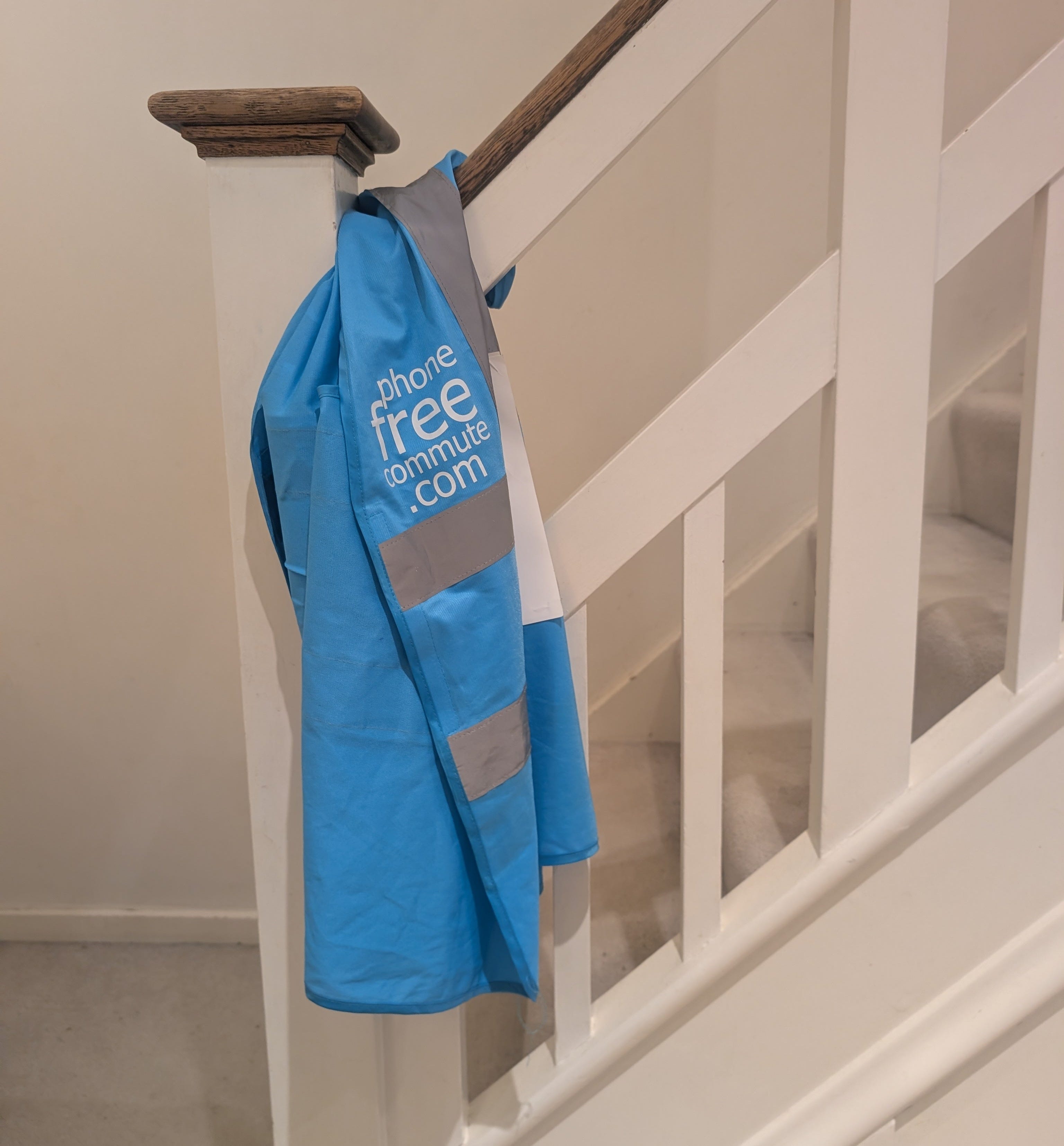
I believe the answer depends on three things:
(1) Thinking/Reason - interrogating the logic of what I’m doing and why on earth I am doing it
(2) External Factors - has someone written a nice comment on one of the posts? Has someone talked to me on the train and told me how much they hate their phone?
(3) Mental Weather - my overall mood, based on the factors outlined above (exercise, sleep, phone use etc)
And having watched closely, I firmly believe (3) is by far the most important factor in how my mind answers the question.
Then comes (2) external factors. (Though obviously they are beyond my control.)
And last of all, (1) thinking, actual reason, coherent thought, interrogating the idea. This is a very distant third, and seems to make very little difference.
By which I mean, if I am in a bad mood about what I’m doing, no matter how I roll the question around in my head I stay in a bad mood. Conversely, if I feel it’s great to be doing this, no new thought dislodges me from that view.
It feels like the arguments in my head about commuting in high vis are just a manifestation of the underlying mood. Which has been shaped by how much I have slept, whether I have exercised, and so on.
Man Who Commutes In High Vis Vest Advocates Not Thinking
This brain in our head is biological. Treat it well, and the world looks good. Treat it badly, and everything looks grim.
If heavy phone use is indeed making people feel more glum, the implications from that are pretty interesting.
You can start to see how phone use could create consequential bad weather in the mind. Let’s say I have a great idea for something I might do, better even than commuting in a high vis vest. It’s a way of changing my life. A new hobby to sign up for, a new thing I might create. I get a little excited. And perhaps I should be, because this new little project might serve to improve my overall brain health.
And then I pick up the phone and scroll. The energy dissipates.
Nah, I think. Let’s not bother.
We could be caught in a digital hangover, a glass half empty mood, without knowing it.
In part this reinforces obvious, well worn advice. Exercise, eat your greens, sleep well, use your phone less, meditate more (or combine the latter two, as I do). And so on. In short, keep a close eye on how you are treating your brain.
But it also suggests something less obvious. To be more suspicious of our thoughts if we haven’t managed to do the above. It reinforces the lesson of my philosophical hangover.
A brain that isn’t well cared for might start to generate all sorts of thoughts that disguise the true problem. The brain doesn’t say oof you used your phone too much. It says what about x? What about y? What do they think of me? Am I okay? And increasingly, maybe I should ask AI for advice?
It’s not like we can choose to stop thinking.
But I’m ready to downgrade the overall importance I ascribe to it, and pay much more attention to the overall state my brain is in.
Less thinking. More high vis idiot.
This is part a series of articles following 1,000 hours of doing nothing - here’s the embarrassing story of how it all began.
If you know someone who’s tired of their phone use (or if you know someone whose phone use you are tired of) feel free to share with them.
There are days when I find it challenging to shake off a bad mood, and most often when I do, it’s because someone has noticed and asked. Rarely happens. Much more often, I find myself recognizing the moods of the children at my school and talk to them. Sometimes they share. Sometimes they can’t, but they do always appreciate that someone noticed, and it often changes their day…and allows them to think.
I believe that this is on the hierarchy of needs. Your physical and emotional needs are more pressing to the body and mind, so when they aren’t fulfilled, you are literally not in a state of mind to do your best thinking.
Have you had any hangovers since the philosophical one?
How many comments have you received on the vest? I’m sure the people on your commute have gotten accustomed to it now. Isn’t it typically the same people day after day?
Reading this is getting me excited about my phone-free week. Thanks for your honesty and humour.