

In the seven years since the ballet disaster I’ve tried almost everything to stop using the phone.
Though nothing solved the problem, most strategies worked a little bit - at least until I undid them.
But you know what never did it for me?
Trying to follow advice that I should be more mindful about my phone use. The sort of advice that goes:
“If you are about to use your phone, STOP. As you pick it up, ask these three questions:
1. Why are you…”
What sorry? What was that question? I was looking at my phone and I kind of drifted off there.
At a certain point I convinced myself that a lot of my phone use was entirely automatic. I couldn’t “catch myself” because I was on autopilot.
Ah well, no matter. I moved on to technique 517.
The mindful phone advice might well work for you. I might have been a special case, because at that time I was a bit of an overthinky mess, living with quite nasty anxiety about work. (I used my phone as a distraction - I suspect it’s all a big loop).
These days I cheerfully talk about doing nothing as if it’s the easiest thing in the world. Back then, doing nothing was genuinely painful.
To deal with my anxious overthinking, I also tried to follow mindfulness advice. I read that a great way of dealing with work stress was to slow down and reconnect with physical sensations.
I’d be desperately worried about how AI was going to take my job and we’d not be able to pay the mortgage.
And I would respond by mindfully loading the dishwasher.
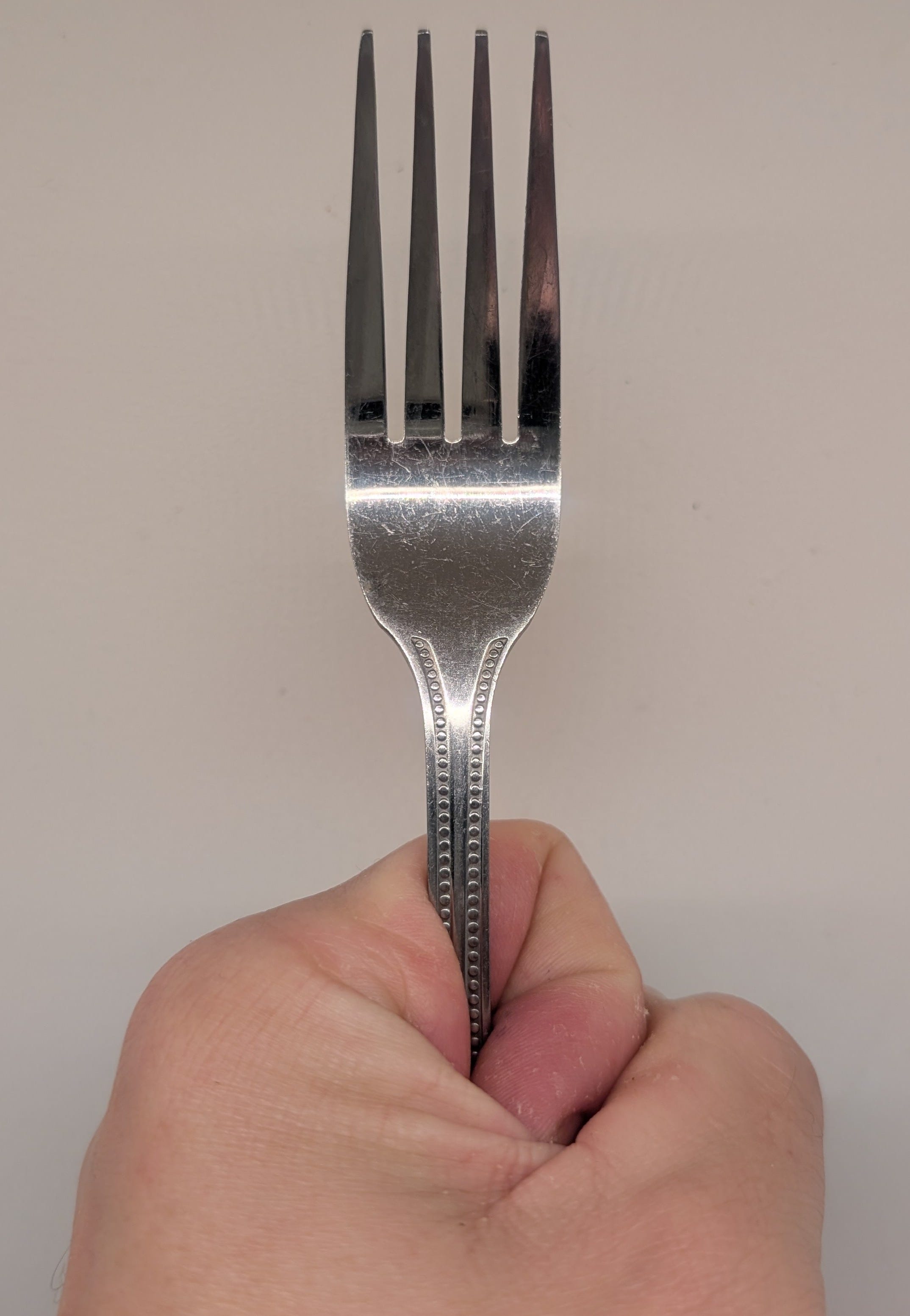
And then I’d be desperately worried about AI taking my job and not being able to pay the mortgage, and also aware I was holding a fork.
Both bits of advice, I’d later realise, had the same flaw. They described where you end up, not how to get there.
You might be surprised by this, given how much I now go on and on and on about woo woo stuff. Surely I should be the one saying, yes, do touch forks, feel their metallic equanimity.
Back in those days, I touched forks inexpertly because I saw mindfulness as the acceptable face of meditation.
Mindfulness = sciencey, evidence-based, thing you learn on corporate courses.
Meditation = religious people, folded legs, smug in sunsets, not cleared for corporate awaydays.
It took reading a lot of books to undo that incorrect impression, and to realise that the skill of mindfulness could be a product of meditation. I also found that meditation was backed by solid evidence, and was something that ordinary people do (an impression I am now doing my best to undo by wearing high vis on public transport).
A quick reassurance before I go on. It is obviously not the case that you need to meditate to cut down phone use.
This Substack is about phones first and foremost - I hope because of my experiences I can offer new ways of thinking about why they might be getting us down.
But personally, as an anxious overthinker, I found meditation was both tough on phone use and tough on the mess of misery that caused phone use.
In brief, the practice I followed at the start was:
I set a timer - 2 minutes was more than enough.
I focused on one thing that was actually happening - in the early days I chose ambient sound. But from what I’ve learnt since, the breath or even repetitive chanting would work just as well. Everything felt easier with eyes closed.
I quite spectacularly forgot what I was doing and my mind did something else entirely. This went on for ages.
Out of nowhere, I suddenly woke up and remembered what I was doing. At that point, I gave myself a relieved pat on the back. I returned my attention to the ambient sound until… back to step 3.
Steps 3 and 4 repeated until ding! The timer went off.
In the early stages at least, posture didn’t matter, nor did it matter where I was.
It was very unpleasant. (3) was nearly always replaying a stupid thing I said in a meeting that might - through a chain of events I could clearly see - leave me destitute and alone.
It felt very pointless. I spent the vast majority of the time drowning in (3) with only fleeting instances of (4). I had no sense of improvement or progress, and did not feel at all better after doing it.
Fortunately, I’d read enough to expect this. Equally fortunately, a big part of my motivation wasn’t immediate relaxation but instead curiosity (read about that here). I knew it would be hard to do daily, so I built surprisingly tech-based habits around it, using a habit app on the front page of my phone that I had to tick each day.
I even signed up for an app called Beeminder, which fined me real money if I failed.
After four or five weeks - and a gradual increase to five minutes a day - lo and behold, things started to change. I remember vividly lying on the sofa and being aware of an impulse to pick up my phone. And newly seeing the thought with some critical distance. And saying no.
I was convinced that without the meditation, the phone would have been automatically in my hand.
This didn’t happen all the time, mind. It didn’t happen enough. But it did happen.
And what’s more, the silence was beginning to be detoxified. I could now choose to do nothing without immediate pain, and when negative thoughts did arise they were robbed of some of their power.
In these moments when I was able to detect an urge to pick up the phone, reject it, and choose to do nothing instead, I had found something valuable: Phone Free Will.
(Zing.)
Mindfulness is fantastic. These days I can notice the fork and the anxiety, because the latter is no longer all-consuming. But this wasn’t something I could just decide to do.
The missing part was training.
What I didn’t realise at the time was that the cycle between (3) and (4) - between forgetting and noticing and returning to focus - was that training. Through the contrast between the intended focus and the unintended interruption, my brain came to recognise that thoughts popped up unrequested. This evolved into an instinctive critical distance from my thoughts, which made them easier to live with.
Playing football, playing a musical instrument, anything. You don’t just read a book and know how to do it. You practise it daily and your brain gradually picks it up. Of course it’s going to be hard to organise and stick to - just look at the huge unused drum kit in our living room.
Perhaps if I’d built a habit around the fork business I’d have got there. But for me it was easier to reliably schedule the meditation.
Maybe we hear more about mindfulness than meditation not just because of the religious associations and the badly photoshopped sunsets. Perhaps we don’t like to admit that sometimes we just need to stop.
Phones are ferociously addictive. The whole world struggles to put them down.
Meditation might be the world’s most abandoned habit. Almost no one consistently does it.
I suspect this isn’t a coincidence. They both have at their heart the challenge of sitting still.
If you don’t fancy meditation, reading, gardening and all sorts will likely get you restorative mental rest.
But if those less stimulating activities are shot through with restless unease, perhaps that’s an echo of the underlying problem.
Writers like me enjoy quoting a famous study in which participants were faced with a choice between doing nothing and giving themselves a small electric shock. Two thirds of the men and a quarter of the women in the experiment chose to shock themselves rather than be left alone with their thoughts.
It’s often told with a slight eye roll at modern minds. But my guess is that those who shocked themselves weren’t tech addicts in need of stimulation. They were overthinky messes like me, whose thoughts were genuinely painful. In which case, they deserve sympathy, not an eye roll.
Please don’t beat yourself up if you can’t catch yourself with three questions before phone use, or if you don’t find comfort in physical contact with a fork.
Though I prance around in my high vis, I don’t mean to make anyone feel guilty for the very understandable act of scrolling away anguish.
And if you do try meditation and it’s horrific and pointless, as far as I can tell, that’s the norm. The cruellest irony is that the people who might most benefit are the people for whom it is hardest to start.
Putting down the phone, or the meditation I describe here, is not at all relaxing.
In fact, relaxation is likely a month away.
Thanks so much for reading! Whether you enjoyed it or found it wildly unfair to mindfulness tips, please let me know in the comments. It’s the only way I’ll learn.
Next week: On This Day many years ago, you were younger, your kids were younger. Where did the time go? Thanks a lot, Phone.
If you know anyone who’s tired of their phone use (or if there’s anyone whose phone use you are tired of) please share this with them.
Confused as to what all this 1,000 hours of nothing business is about? Start here.
I saw a statistic that said most people will spend an average of 15 years of the life on their phone.
I typed this on my phone. I've got a tracker app and last week, I managed to. Curb a lot of time on there, but of course my devious brain tried to go on social media on the TV/Mac instead.
I know meditation helps, but it's been years since I've done it and I'm scared to see how hard it is now. I guess it's probably about time to rip off the plaster of patience and feel the boredom...
How funny, I just wrote an article over the weekend about a very similar topic (it’s not quite finished). :) You described my experiences with meditation so accurately! (Except I never got anywhere, because I wasn’t doing it long enough.) :D But I believe it is one thing that could actually help…