

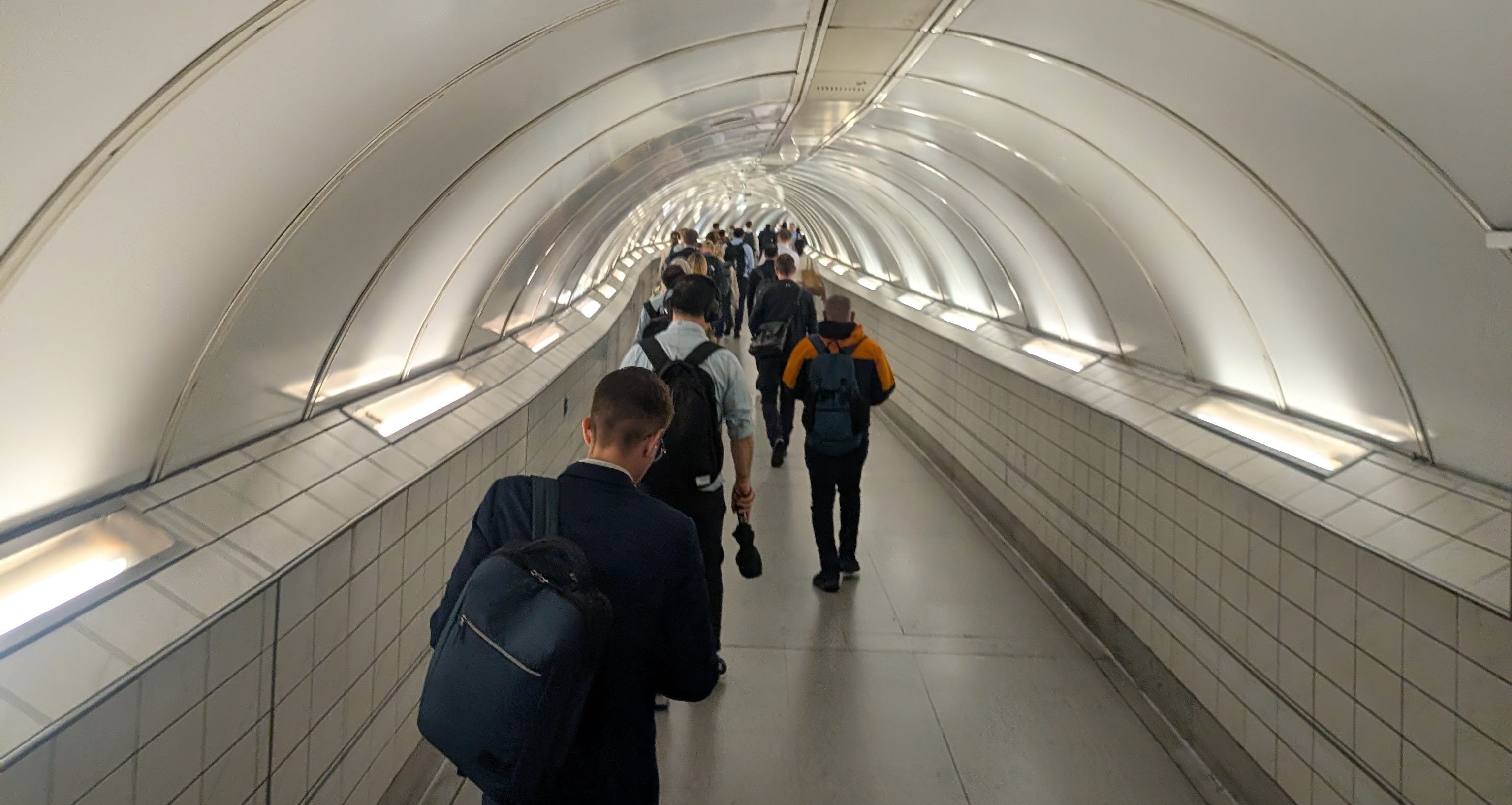
A few years ago I changed job, and as a result I had to go East rather than West on the Central Line at Oxford Circus. But my brain kept me going the old way for ages. It was like I was caught in a current. I had to double back when I snapped out of it.
If there’s one thing I’ve learnt from commuting over two decades, it’s humans’ formidable capacity for continuity. We commuters do each day what we did the day before. We all stream up and down the stairs in Waterloo as one, as surely as if we were on rails. Our routes through London mirror well-worn neural pathways. We can’t change it easily - no sudden moves allowed.
Very gradual change we can manage. Christian Wolmar would be able to trace the decline of the hat, the decline of the suit. And the arrival of the phone, first held by one, then many, then all.
When I saw that some of my phone use was automatic, I believed that I had caught sight of the brain’s underlying, overwhelming unconscious adherence to continuity.
You use the phone a lot, says the brain, so let’s keep doing so.
(Read last week’s piece here - part one of three marking six months of phone free commuting, and explaining what all of this is about).
How to root out this automatic impulse?
I had tried everything and it had failed. Whatever obstacles I put in the way of my phone use, I cheerfully dismantled. Now I had seen that the impulse to pick it up was entirely unconscious, I was ready to try anything to intercept it at the source.
After nearly four years of trying everything, could meditation help fix my phone addiction?
I read a lot of books, and listened to a wonderful Jeff Warren course on the app Calm. (Incidentally, it was wonderful more because of Jeff Warren than Calm - please look him up on Substack if you are interested).
The overriding message was to forget the image of relaxation, and to embrace daily training. A little like learning an instrument.
I learnt to set a timer for a short period, say five minutes, and to choose something to focus on for that time. Traditionally one chooses the breath, but I learnt it could just as easily could be an ambient noise. I chose the sound of the fridge. As it seemed less spiritual.
I closed my eyes, concentrated on the fridge sound, and…WHOOMPH. I completely forgot what I was doing. I spent all the time thinking about how Clive from work hated me. And then the timer went off. Great.
Luckily, I had taken good advice. I knew this wasn’t a failure. I knew the mission was to come back the next day and try again.
Same time tomorrow.
But of course the same thing happened again. And again.
So I gave up.
Meditation is perhaps the world’s most abandoned habit.
But I had two advantages.
Firstly, I had a problem I wanted to solve. A problem that I already knew had major effects on my family life. And a problem that interested me.
My second advantage was that in years of fighting the phone I had learned not to underestimate how hard it is to start a new habit. So I signed myself up for an app that fined me if I didn’t meditate.
And… I got fined quite a bit. A month or so in, my wife noticed the payments.
The embarrassment of having paid out over 100 dollars (the app was American) for failing to regularly do nothing was all too much.
I started again, with my tail between my legs.
But for weeks it was the same. Try to focus. Forget. Feel no change.
It wasn’t that I was distracted. It was that all thought of meditation was totally obliterated. My little boat of fridge focus was capsized by a massive wave that I didn’t see coming. A whole load of thoughts about whether I should have written “All my best” on a work email.
Until one day, a few seconds or even minutes later, my tiny boat bobbed back to the surface. I remembered that I was meditating. I returned my focus to the fridge.
And this moment of recognition was the moment I had been training for.
In that second of coming back to focus, there’s an opportunity to clock that a thought arose that I didn’t originate.
Conscious me didn’t think that stuff about the “All My Best” email. Conscious me was aiming at the fridge.
Who changed the channel? It was the hidden mind. Aha! Saw you.
This observation, I learned, was mindfulness. The ability to observe my own thoughts without getting sucked into them.
I kept training. The gaps where I could concentrate on the sound of the fridge became longer. Even pleasant.
As my focus improved, so the unauthored incursion of old thoughts stuck on repeat became even more glaringly obvious.
My wife and I get on very well (that’s loving, isn’t it). But our Achilles heel is tidying the house.
One day my wife suggested that we should perhaps tidy the kitchen. My habitual response would be to interpret this suggestion as a veiled attack. She was, I believed with all my heart, secretly saying it was all my fault.
My usual move in this situation was to expertly parry her concealed attack by talking about a time some two months back when she had left out some dirty plates. Take that.
Until one day - and I remember this vividly - the instinct to say that arose, and I saw it in embryonic form! I saw it with the same clarity, the same distance that I saw my thoughts meditating.
And I said to myself, maybe I won’t say that.
And we tidied the kitchen without arguing.
And house harmony was improved.
It was a transformative moment.
Across my life I could suddenly see all sorts of well-worn negative behaviours and intervene before they happened. When I was driving and someone cut me up, I had an automatic impulse to do an middle finger gesture below the dashboard. Now gone! I stopped barking at the kids in the morning, even when they were eating cereal so painfully slowly.
I used my new skill all the time. Sometimes, when my wife was speaking to me about some chore or other, I would decide to concentrate hard on my mindfulness. My eyeballs would even bulge a little, and she would say “Are you being mindful now? Because that’s brilliant if you are.”
Many years ago I had read all sorts of articles extolling the virtue of mindfulness. I had even been on corporate courses. But for me personally none of it clicked, none of it was possible, without the meditation - without the regular training of a distance between me and my thoughts.
After all, no one learns how to play a guitar by reading articles about it.
When I had picked up the phone, I had asked “Who’s Me?”
My answer at this point would have been clear. The real me was the part of me that was mindful. If I could strengthen that me, it could observe well-worn patterns from a distance and then decide whether or not to action them.
But if mindfulness was about me versus continuity, it turned out that phone use was the boss battle. Of all the ingrained negative habits, the one that started this whole thing was the most stubborn.
Until one day, I was lying on the sofa in between other things with nothing to do. I vividly remember mindfully observing a call to pick up the phone. I firmly believe it would have been automatic before.
And then, thanks to my newfound comfort with doing absolutely nothing, I did that instead.
I lay on the sofa and rested. Maybe for the first time in years.
A decline in automaticity, and a comfort in doing nothing. Together they gave me a taste of free will over my phone.
Boy, do people who learn to meditate go on about it. I remember feeling it was the third best thing to have happened in my life after marriage and kids.
And, what’s more, it was the first thing that seriously reduced my screen time.
Arguably this would have been a great place to stop.
But I had the bit between my teeth now. Though I had a taste of success, I still didn’t have the full control over my phone use I set out to find.
I decided I needed more time to meditate. I increased my daily dose to an hour each day. But the kids kept ruining it.
So I searched for a huge block of available time.
And soon enough the sound of the fridge was replaced. By the sound of the train.
And I went deeper.
Wondering how weird this is going to get? Read Part Three
If you know someone who’s tired of their phone use (or if you know someone whose phone use you are tired of) feel free to share the joy of Phone Free Will.
Encouraging and intriguing.
Really enjoyed this as always. It just made me laugh straight from the off it wasn't going to follow the usual zen like feel meditation.
Clive cracked me up. I'm sure Clive is a recurring thing right? I'm not imaging that right? the fact that it didn't work for ages and that you kept abandoning it and coming back to it - i reckon thats the part most people skip and go straight to the breakthrough.
It also made me laugh because I've tried meditation and mindfulness myself - and quite alot given the success rate - but eventually realised it was probably the last thing I needed — I spend enough time in my own head already. My version of relaxation is absurdly loud thunderstorm sounds right next to my ear (thats true -lol)
great story telling and writing as always