

I have long resisted the urge to write about how the commute has been transformed into something wonderful because ugh.
But I’m reluctantly breaking that habit due to a very odd experience last week on the 1853.
As long time readers will know, the true benefits from going phone-free aren’t actually felt on the commute, but are enjoyed 24/7.
The commute itself is pretty unpleasant for the first few weeks. And then becomes neutral.
But I’ve now done this for four months, and clocked up 116 hours. And it’s got interesting.
There is lots to be said in time about what I think about, my relationship with my thoughts. All that.
But the odd thing first.
The Steam Train Paradox
When the kids were younger we’d go for rides on steam trains. The start is very exciting, seeing the locomotive blow off steam.
And then you get on the carriage and you realise that you are just in a train. The fact that onlookers are seeing a beautiful old locomotive doesn’t benefit you - you could only see that by sticking your head out of the window. You’ve bought an expensive ticket for a normal train ride. So you have to try and enjoy it.
Last Thursday I started my commute home after a tough day at work. Previously I would have scrolled away to distract myself from it. But as I pulled out of Waterloo and looked out of the window, I remembered the steam train.
And I wondered… can I choose to enjoy this journey?
And yes, it turned out I could. The journey from Waterloo to Surbiton is not pretty. I would never say it was. But there is a lot to look at and if you are in the right mood it reminds you of a fun day out.
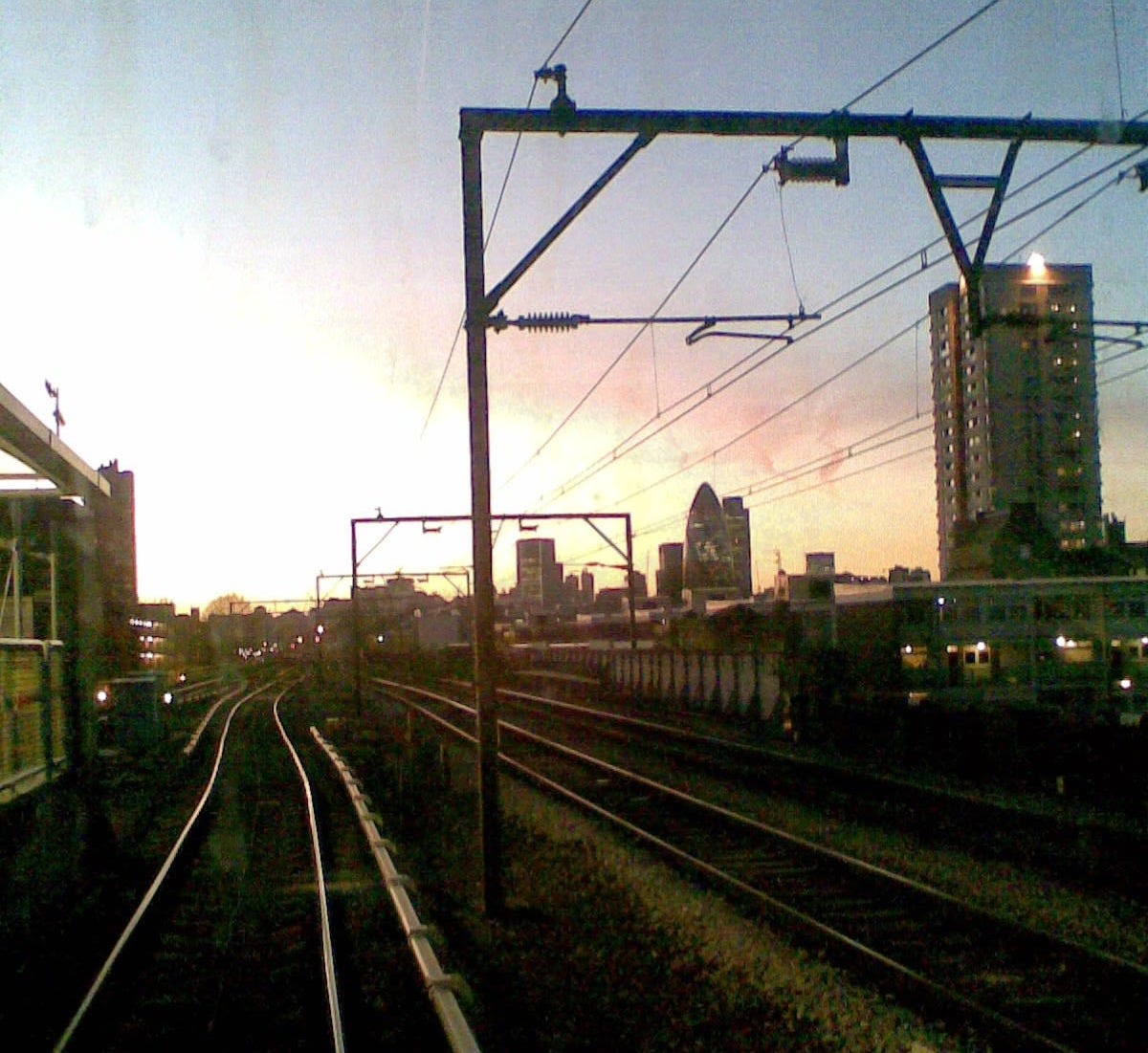
Near Vauxhall there’s streets full of Victorian cottages. A tourist would love to see the way the chimneystacks wind up the hill.
If you’re watching closely, the approach to Clapham Junction is spectacular. It’s way more interesting than the little halts you get on steam railways
When our train pulled out, it did so exactly at the same time as the Gatwick Express. Our trains bobbed along together and I could see inside the other carriage. For a second I had an instinct to wave at the people in the other train. But they were all on their phones.
I looked at the tops of the trees that marked the edge of the railway. I had always thought these dismal. But they are the same species of trees you see in a country walk, and that day they lost their grim trackside context and looked like country trees. Proper trees.
At Berrylands I could see into people’s gardens. Kids were bouncing on trampolines and I could imagine a smell of spag bol.
I couldn’t see it, but I knew we went under the railway bridge at Surbiton where parents sometimes take their toddlers to look at the trains. Before they learn they are just commuter trains.
We all grow up. It reminded me of those black and white photos of crowds of trainspotters. It occurred to me that was a very pre-phone hobby. Before we had other things to do.
When we pulled into Surbiton, people got up to go. Most put their phones in their pockets, but a man my age walked up beside me still using his. He looked at my stupid high vis vest with (understandable) fatherly disappointment.
I glanced at his phone. He was playing one of those games where you manage a little town. Like the one we just went through.
Finding Beauty In The Everyday Ugh
There are tonnes of people who tell you to look at the everyday through fresh eyes and find it beautiful. To appreciate every detail.
I firmly believe this advice is horsecrap. Personally, if I had tried to do that as a commuter on this same line many years ago I would have failed. And I likely would have thought less of myself in failing.
This is why I was hesitant to write an article like this.
But here I am. That annoying person.
What changed? 116 hours. I firmly believe that my 116 hours of phone free silence have made it far easier for me to take pleasure in the everyday.
Heavy phone use encourages the mind to look at normal life with uneasy, restless disappointment. Conversely, to spend time in silence is to teach your brain to accept that ordinary things are okay.
This is an invaluable training of the mind.
I’d suggest that if you can find the joy in the commute, you can find it in a lot of places. You can appreciate everyday life not as a result of deliberate effort, but as a default. You can treat life with a little more lightness. Its challenges can be more like the game the guy was playing.
So my advice isn’t to take pleasure in the everyday. I’m not saying it isn’t important. There’s a reason why it’s the message of so many movies and so much philosophy. It’s true that it’s a key part of happiness.
It’s true. But it’s not helpful advice.
My suggestion instead is to put down your phone for a few minutes every day.
And one day, taking pleasure in the everyday might happen. Not because you chose it, but because it became choose-able.
Thanks so much for reading! If you know anyone who’s tired of their phone use (or if there’s anyone whose phone use you are tired of) please share this with them.
This is part of a series of articles following 1,000 hours of silence on the London commute. The very strange story of how that started is here.
All my posts, both new and archive, are free and are neatly categorised at phonefreewill.com.
"Realizing you are just on a train" is an excellent metaphor for a lot of what we covet. I love it. Also, to your thing about the train ride not being beautiful. I grew up taking a similarly ugly train ride. There is some soul-enhancing joy to figuring out how to find beauty in boring infrastructure.
My commute being in a car, the phone scroll isn’t an option. Yet, it was seldom medatative. Spotify, and my liked songs are always there. In the morning to pump me up for my day, and on the way home to decompress from the stress of the workday by replacing it with music that sings to my heart.
I’ve been riding quietly to try a more deliberate meditation. In the mornings I found my mind “looking forward” to the list that always awaits me when I get there….not mind soothing. On the way home, I find that my mind is on the traffic around me more than when I am soothed by my music. Not in a good way. The ride seems longer. This time of year it is with the heavy traffic from the cannery changing shifts. The weather sweltering and my a/c no longer at its prime.
But as I exit town, and enter my country neighborhood, I do begin to feel my mind relax. Still waiting for enlightening moments. This may not be the right time for me. I’m thinking it’s going to be a porch chair.