

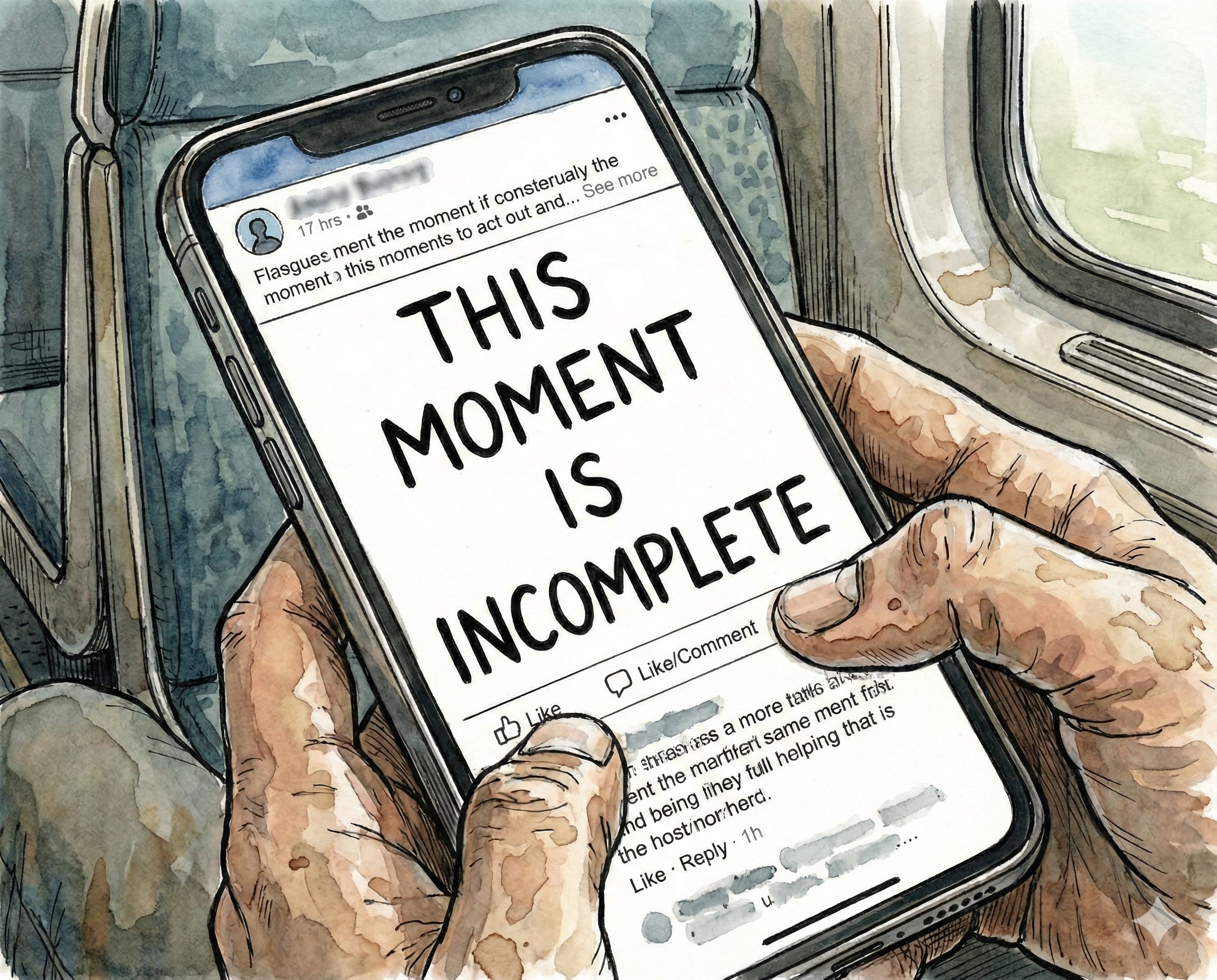
The world and her mother say you need to take a regular break from the phone. You have probably got that message by now.
I am arguing for something more active: making a daily date to train your mind to undo the damage the phone does. (Read more here).
The main aim of that training is to stop the ingrained habit of automatically picking up the phone at home. So you can it own it, rather than it owning you.
But it also had - for me at least - an unanticipated benefit.
A couple of weeks ago, I wrote that I noted an odd sense of optimism creeping in at around Day 30 of my Phone Free Commute. It was glorious and quite lovely.
But I couldn’t work out what was going on. I think I have it figured out now.
The Science Bit
Neuroscientist and Substack writer Dr. Dominic Ng recently argued that phone use changes your brain.
Dopamine is the brain's neurotransmitter of motivation and reward: an anticipatory signal released to reinforce behaviours essential for our survival, such as finding food or shelter.
Evolution favoured dopamine for a reason. It made our ancestors look at a spear and say: “Not good enough, I’ll shape it better”. This extraordinary relentless impulse created the Pyramids, fractional reserve banking and Surbiton station.
For him, the phone hijacks this instinct to check, fix, and improve, turning it into an endless activity.
He argues -
Constant phone use stimulates constant dopamine release. The brain’s reward processing hub responds to this flood of dopamine by removing receptors, essentially “muffling” the signal from the dopamine. Accordingly our mood in general worsens. We find it harder to find joy in normal levels of stimulation.
Repeated phone pickups are associated with less activity in the prefrontal cortex, which is the decision-making centre of the brain.
Ng suggests many useful remedies for tackling excessive phone use.
But, perhaps surprisingly, he also suggests meditation.
He describes how a long-term daily habit (rather than a sudden short detox) reinforces the wiring in the prefrontal cortex, allowing our phone use to be less automatic and more intentional.
And then gradually, thanks to neuroplasticity, the dopamine receptors come back.
His piece is very interesting, and could help explain my improved mood.
But the challenge is making it all feel tangible. We can’t perceive dopamine or the Prefrontal Cortex. On the other extreme, meditation feels vague or even off-putting to some, and it’s really hard to imagine how it’ll help address chemical imbalances.
But I believe it is possible to connect the emerging neuroscience with our felt experience. There’s an honorable tradition from Plato to Freud of using metaphor and story to envision the mind.
Using our imagination creatively can help us see how mental training can defeat the phone’s grip on us.
Plus it can be quite entertaining too.
The Evil Advisor
The moment you commit to a break from your phone, your mind invents a reason to pick it up.
For me, it’s heard as the voice of an Evil Advisor, endlessly suggesting a variety of increasingly desperate (and hilarious) reasons why I need to use my phone.
The Evil Advisor is how I feel dopamine. It’s the instinct to check, to fix, to improve.
The Advisor is never sated. And he mixes stupid tasks (let’s refresh the feed yet again! that next video might be better!) with ones that genuinely need doing.
If you’re just generally trying to cut down phone use, you’ll judge his requests on merit. Good point, even though it’s near midnight, I should indeed order Tommy’s new school trousers now, because he looks like a doofus.
But this isn’t about merit of each use of the phone. It’s about us checking and fixing and improving 24/7, which only serves to amplify the calls to do so - until we hear the relentless drumbeat of unease all the time, day and night.
That’s why we need a daily period of intentional training, so you can say firmly, whatever the merit of the Advisor’s request, No, I will do that later.
In the silence you have carved out, you are practising so you can hear that call to the phone clearly. (He’s fully capable of controlling you without a whisper otherwise).
And you are practising saying to him: I accept that I do not know everything. I accept that - though this could be checked, fixed or improved - I will not do so right now.
To me, that is what it feels like in the moment to strengthen the Prefrontal Cortex and to “regrow” your dopamine receptors.
To get a sense of how it’ll feel over weeks and months, I believe it’s useful to learn from the world’s great contemplative traditions.
The Guy In The Garden Centre
Ng is one of a number of experts calling for meditation in the battle against phones.
It’s perhaps no surprise that those who watch the mind closely would perceive the effect of dopamine in the mind, centuries before neuroscience classified them.
Until I became obsessed with my phone use, the Buddha was just a guy I occasionally encountered in garden centres, often as part of a water feature. He did not live to see smartphones but, from what I’ve read, I suspect he would not have been a fan.
He described the felt effect of dopamine in the brain: the human tendency to feel every moment is unsatisfactory and incomplete. He called it Dukkha.
He also noticed that “Whatever a person frequently thinks and ponders upon, that becomes the inclination of their mind” - a perfect description of the well-worn neural pathways that make phone pick ups automatic.
And of course he noticed the effect of regular mental training. He knew that diligent concentration could redirect the mind - anticipating neuroplasticity.
I don’t personally believe the universe or the cosmos is telling me anything. Nor do I believe in reincarnation or anything outside of the physical world. As far as I know, my brain is a strictly biological thing that creates my conscious experience.
But I don’t believe you have to be religious to admire how the contemplative traditions have documented the weirdnesses of the mind. They were the first cognitive scientists.
And where they are especially helpful are in describing how a daily project to rewire the brain feels.
Meditation literature warns us we will naturally be assailed by negative thoughts, and that if we keep distracting ourselves from them, they’ll just come back with a vengeance.
It says that in those moments when you are able to place your attention on the sounds around you, or the breath, you should celebrate it. Training the mind to be present is the best training of all.
And the literature also tells us that none of this will feel easy. That the right attitude to have is one of patient training.
And that last message is probably the most important one. Of all the lies told about the phone, the most dangerous is that you feel good when you put it down.
You are turning away from the path of least resistance. Well worn mental wiring screams at you. Your Evil Advisor screams at you.
But you say: No, not now. I accept the uncertainty and the incomplete task. You grit your teeth.
A few weeks, and the automatic use of the phone might slow, ending the forlorn battles and guilt at home.
A few weeks, and you might feel a mood you haven’t felt for years.
A few weeks, and you might be out of this glum fog.
(For an FAQ, read more here)
So the ability to keep your terms, even though it’s challenging, is a win? It feels like a weakness.
The bit about it not feeling good when you first put the phone down is so important, because nobody talks about that part. People expect instant relief and then feel like they've failed when the discomfort hits. That's exactly when the rewiring is happening!